Best Laminate Flooring: How to Choose the Right Product for Your Project

- 2026/10/7
- By Colin Pun, OKBuild Project Manager
Table of Contents
ToggleThe best laminate flooring is not simply the thickest plank, the highest AC number or the product with the strongest “waterproof” wording on the package.
A better product is one whose construction, surface performance, joint system, installation requirements and supporting documentation are appropriate for the project’s traffic, moisture conditions and intended use.
That distinction matters because two laminate floors can look almost identical but have very different specifications.
For a bedroom, surface design and walking feel may be important. For an apartment, acoustics and finished floor height may become critical. For a hotel or office, abrasion, castor-chair traffic, maintenance and future replacement may matter more.
Instead of asking:
“What is the best laminate flooring?”
a more useful question is:
“What is the best laminate flooring for this room, traffic level, substrate and project requirement?”
This guide provides a practical method for screening, comparing and approving laminate flooring before ordering.
For a broader explanation of laminate construction, thickness, AC ratings and water resistance, start with OKBuild’s Laminate Flooring Guide.

What Does “Best Laminate Flooring” Actually Mean?
There is no single laminate floor that is best for every building.
A high-quality laminate product should be evaluated as a complete flooring system, not by one headline specification.
Useful factors include:
| Factor | What It Helps You Evaluate |
|---|---|
| Surface performance | How the decorative surface responds to expected wear |
| Core construction | Rigidity, dimensional behavior and overall plank construction |
| Locking system | Joint integrity and installation |
| Water performance | Conditions the exact product is designed to resist |
| Thickness | Floor build-up, rigidity and coordination with adjacent finishes |
| Underlayment | Support, acoustics and system compatibility |
| Intended use | Residential, commercial or other permitted applications |
| Installation requirements | Subfloor, expansion, moisture and layout conditions |
| Documentation | Whether important performance claims can be verified |
| Design | Appearance, texture, plank format and pattern repetition |
| Replacement strategy | Whether matching spare stock can be maintained |
Industry laminate performance standards evaluate multiple characteristics separately, including wear, impact, moisture resistance, dimensional stability, static loads and castor-chair performance.
That is why one number cannot define the entire quality of a laminate floor.
A Three-Step Method for Choosing Laminate Flooring
A practical purchasing process can be divided into three stages:
1. Screen
First eliminate products that clearly do not meet the project requirements.
Check:
- Room type
- Expected traffic
- Moisture conditions
- Required floor height
- Substrate
- Installation method
- Commercial or residential use
- Acoustic requirements
There is little value comparing colors and prices if the product is unsuitable for the intended room.
2. Compare
Once unsuitable options have been removed, compare the remaining products on the same basis.
Align:
- Thickness
- Core
- Abrasion classification
- Joint system
- Water-performance claim
- Underlayment
- Dimensions
- Installation
- Warranty
- Technical documentation
3. Approve
Before the final order, confirm the exact:
- Product code
- Color
- Size
- Quantity
- Batch
- Packaging
- Spare-stock quantity
- Installation requirements
This prevents a general sample or marketing description from being mistaken for the final approved product.
How to Identify High-Quality Laminate Flooring
The phrase high quality laminate flooring should describe more than appearance.
A useful assessment begins with the following areas.
Surface Performance
The surface layer is responsible for protecting the decorative image underneath.
Depending on the project, buyers may need to evaluate:
- Abrasion
- Scratches
- Stains
- Impact
- Cleaning
- Light exposure
Do not assume that one rating covers all these properties.
For example, an abrasion classification does not automatically prove identical scratch, impact or water performance.
For commercial flooring, ask what tests or classifications apply to the exact model.
Core Construction
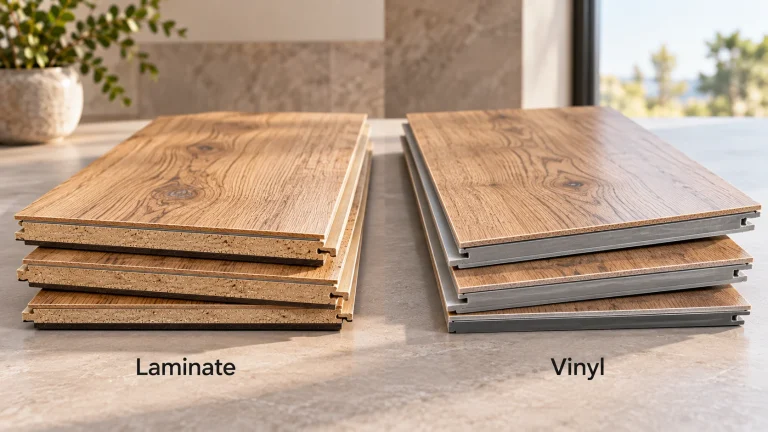
Laminate flooring normally contains a wood-fiber-based core.
The core contributes to:
- Plank thickness
- Rigidity
- Dimensional behavior
- Joint construction
However, terms such as HDF alone do not prove complete product quality.
The surface, joints, manufacturing consistency and installation system still matter.
Locking System and Joint Quality
The joint is one of the most important parts of a floating laminate floor.
When comparing physical samples, inspect:
- Joint engagement
- Edge condition
- Alignment
- Visible gaps
- Chipped corners
- Manufacturing consistency
A thick board with poor joints is not automatically a better floor than a thinner product with a well-designed system.
Water Performance
Water resistance should be evaluated at product level.
Important questions include:
- What water exposure is covered?
- Are the joints part of the claim?
- Are edges treated?
- Does installation affect the claim?
- Are bathrooms or kitchens permitted?
- What conditions are excluded?
Do not use the word waterproof as a substitute for technical verification.
For a deeper explanation, see OKBuild’s Waterproof Laminate Flooring Guide.
Thickness
A thicker laminate plank can provide a more substantial profile, but thickness is not an overall quality grade.
12mm does not automatically mean:
- Higher abrasion resistance
- Better water performance
- Better scratch resistance
- Longer service life
- Better commercial suitability
For a detailed comparison of 6mm through 14mm products, see OKBuild’s Laminate Flooring Thickness Guide.

Best Laminate Flooring Selection Matrix
When several products remain after initial screening, use a consistent comparison table.
| Specification | Product A | Product B | Product C |
|---|---|---|---|
| Product code | Confirm | Confirm | Confirm |
| Dimensions | Confirm | Confirm | Confirm |
| Thickness | Confirm | Confirm | Confirm |
| Core | Confirm | Confirm | Confirm |
| Surface / abrasion classification | Confirm | Confirm | Confirm |
| Scratch / impact information | Confirm | Confirm | Confirm |
| Water-performance claim | Confirm | Confirm | Confirm |
| Locking system | Confirm | Confirm | Confirm |
| Attached pad | Confirm | Confirm | Confirm |
| Additional underlayment | Confirm | Confirm | Confirm |
| Approved rooms | Confirm | Confirm | Confirm |
| Residential / commercial use | Confirm | Confirm | Confirm |
| Subfloor requirements | Confirm | Confirm | Confirm |
| Installation instructions | Confirm | Confirm | Confirm |
| Warranty | Confirm | Confirm | Confirm |
| Technical reports | Confirm | Confirm | Confirm |
| Material price | Confirm | Confirm | Confirm |
| Installed project cost | Confirm | Confirm | Confirm |
| Spare stock | Confirm | Confirm | Confirm |
This makes it much easier to identify whether a price difference reflects an actual specification difference.
Best Laminate Flooring for Dogs and Pets
For homes with dogs, do not choose laminate only by thickness.
Instead, prioritize the exact product’s:
- Surface abrasion performance
- Scratch information
- Stain resistance
- Cleanability
- Joint quality
- Moisture conditions
- Surface texture
Dogs can introduce several stresses at the same time:
claws + tracked-in grit + spills + repeated traffic
A product marketed as “pet friendly” should still be checked against its actual technical information.
Also consider the surface texture.
Extremely smooth flooring may behave differently under paws than a more textured finish, particularly for larger or older animals.
Neither laminate nor any other flooring material should automatically be described as scratch-proof.
Best Laminate Flooring for Kitchens
Kitchens require a different screening process from dry bedrooms.
The most important issues include:
- Surface spills
- Sink areas
- Dishwasher or refrigerator leaks
- Cleaning
- Joint protection
- Edge details
- Installation requirements
A suitable water-resistant laminate may work in some kitchens, but the exact product must be approved for the application.
Do not select kitchen laminate simply because it is 12mm or has a high abrasion classification.
Water performance is a separate requirement.
Best Laminate Flooring for Living Rooms and Bedrooms
Dry residential areas give buyers more flexibility.
For living rooms and bedrooms, the decision may place more emphasis on:
- Appearance
- Walking feel
- Acoustic comfort
- Thickness
- Budget
- Furniture
- Cleaning
- Floor height
8mm, 10mm or 12mm products may all be reasonable depending on the complete specification.
In these rooms, physical samples are especially important because the floor becomes a major visual surface.
Check several planks together rather than approving only a small color chip.
Best Laminate Flooring for Apartments
Apartment projects often introduce requirements that are less important in a detached house.
These can include:
- Impact sound
- Underlayment
- Door clearance
- Corridor transitions
- Repeated installation
- Replacement stock
- Unit-to-unit consistency
Do not assume that thicker laminate automatically solves acoustic requirements.
Acoustic performance depends on the complete floor and building assembly.
For multi-unit projects, confirm the required acoustic documentation before final product approval.
Best Laminate Flooring for Commercial Use
Commercial flooring selection should begin with the actual use zone.
A hotel guestroom is different from a busy retail entrance.
An office meeting room is different from an area with continuous castor-chair traffic.
Consider:
- Foot traffic
- Abrasion
- Chair castors
- Rolling loads
- Furniture
- Cleaning equipment
- Entrance grit
- Replacement access
- Maintenance closures
A product described as commercial should still be checked against the intended use.
For projects comparing laminate with other flooring categories, see OKBuild’s Commercial Flooring Materials Guide.
What About Bathrooms and Basements?
These areas deserve more caution.
Bathrooms
Do not approve laminate for a bathroom simply because the product uses a waterproof or water-resistant marketing term.
Verify:
- Whether bathroom use is permitted
- Water-performance conditions
- Perimeter requirements
- Cleaning limitations
- Installation details
- Warranty exclusions
Laminate flooring does not replace required wet-area waterproofing.
Basements
For basements, the substrate may be more important than the visible flooring.
Before selecting laminate, investigate:
- Concrete moisture
- Below-grade conditions
- Vapor control
- Existing water problems
- Manufacturer installation limitations
Do not install a more expensive laminate product in an unresolved moisture condition and expect the flooring itself to solve the problem.
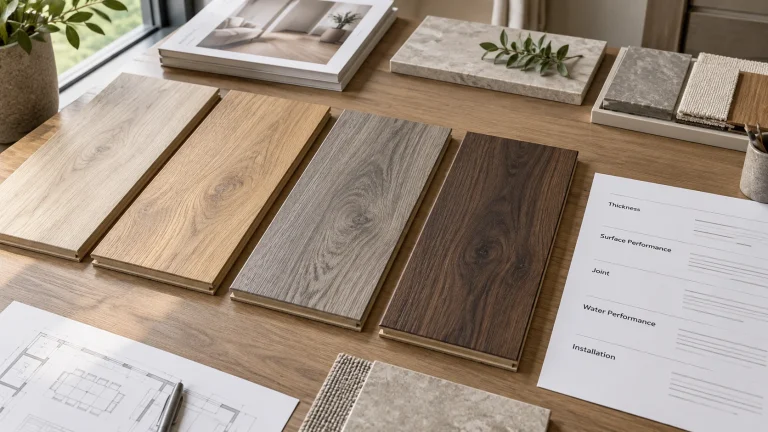
How to Compare Laminate Flooring Samples
Technical specifications are important, but physical samples can reveal information that a spreadsheet cannot.
When evaluating samples, compare them under the same lighting.
Look at the Surface
Check:
- Wood pattern
- Color
- Gloss
- Texture
- Embossing
- Bevels
A realistic sample should also be evaluated across several planks.
One plank cannot show how frequently the décor image repeats.
Inspect the Edges
Look for:
- Damage
- Chipping
- Uneven bevels
- Inconsistent joints
- Surface defects
Connect the Planks
If possible, connect several samples.
Observe:
- Joint alignment
- Surface level
- Visible gaps
- Connection feel
Physical sample inspection can reveal fit, finish and manufacturing consistency, but it does not replace standardized performance testing or product documentation.
The sample inspection is for manufacturing and design evaluation, while technical performance should come from appropriate product documentation.

How to Compare Laminate Flooring Quotations
One of the biggest purchasing mistakes is comparing only:
price per square meter
or:
price per square foot.
Supplier A may quote a lower material price but exclude important project components.
Supplier B may include a different product specification or installation package.
Before comparing prices, align the scope.
Compare the Product First
Check that the quotations refer to comparable:
- Thickness
- Dimensions
- Surface specification
- Core
- Joint
- Water performance
- Underlayment
- Application
Compare the Package
Then check:
- Flooring quantity
- Waste allowance
- Packaging
- Underlayment
- Adhesive if relevant
- Transitions
- Skirting
- Freight
- Duties
- Installation
- Subfloor preparation
- Spare stock
The cheapest material price does not necessarily produce the lowest total project cost.
What Documents Should You Request Before Buying?
For a small residential project, the documentation may be simple.
For a larger commercial or development project, buyers may need more formal information.
Depending on the project, request:
| Document / Information | Why It Matters |
|---|---|
| Product data sheet | Confirms basic construction and dimensions |
| Installation instructions | Defines substrate and installation requirements |
| Performance classification | Helps verify intended use |
| Water-performance information | Defines limits of moisture claims |
| Test reports where required | Supports specified project performance |
| Warranty | Defines conditions and exclusions |
| Packing information | Supports quantity planning |
| Approved sample | Confirms final design |
| Product code | Prevents substitution |
| Batch information | Helps manage appearance consistency |
Request documentation that applies to the exact proposed product and supports the relevant project requirements.
Common Red Flags When Choosing Laminate Flooring
“12mm Means Premium”
Not necessarily.
Thickness is one specification.
“AC5 Means the Best Laminate”
Not automatically.
Abrasion resistance is important, but it does not define every performance characteristic.
“Waterproof Means It Can Go Anywhere”
No.
Verify the exact water claim and permitted installation conditions.
“HDF Means High Quality”
HDF describes a core category, not the complete quality of the flooring.
“Commercial Grade” Without Supporting Information
Ask what classification or intended-use documentation supports the claim.
Choosing Only by Color
Appearance matters, but it should come after the product has passed the technical screening.
Comparing Prices Before Aligning Specifications
A cheaper product with a different specification is not a direct comparison.

Brand vs Product Specification: What Matters More?
Brand reputation can be useful when evaluating manufacturing consistency, documentation and after-sales support, but the brand name alone does not determine whether a specific laminate product is suitable for a project.
Large flooring manufacturers may offer many different product lines with different:
- Thicknesses
- Surface classifications
- Cores
- Joint systems
- Water claims
- Installation requirements
- Prices
Therefore, buyers should compare the exact model, not only the manufacturer name.
The best laminate flooring brand for one buyer may not provide the best product specification for another project.
For developers and commercial buyers, product-level documentation is generally more useful than a generic brand ranking.
OKBuild Laminate Flooring Options
OKBuild’s laminate flooring catalog includes plank and parquet-format products.
Catalog examples from the EF and RY Series are shown at 1219 × 200 × 12mm
while selected Parquet Series products are shown at:
805 × 403 × 12mm.
These examples demonstrate that one thickness can be offered across different visual formats and designs. George floor&staircase-4M George floor&staircase-4M
The appropriate choice still depends on the project specification.
Do not assume that every design automatically carries the same:
- AC rating
- Water claim
- Warranty
- Commercial classification
Confirm the exact product before ordering.

How OKBuild Supports Laminate Flooring Procurement
For larger residential and commercial projects, flooring selection needs to coordinate with the rest of the interior package.
OKBuild can work from project information such as:
- Architectural drawings
- Flooring schedules
- BOQ
- Room types
- Quantities
- Design references
- Required specifications
- Delivery location
This allows the flooring package to be reviewed together with other project interfaces such as:
- Doors
- Cabinets
- Wardrobes
- Skirting
- Stairs
- Tile
- Stone
- Bathroom thresholds
For projects using several flooring types, this coordination can be more useful than selecting each material independently.

Best Laminate Flooring FAQs
What Is the Best Laminate Flooring?
The best laminate flooring is the product whose performance, installation requirements, appearance and cost match the intended project.
There is no single product that is best for every room.
How Can You Tell if Laminate Flooring Is Good Quality?
Check the complete specification, including surface performance, core, joints, water-performance information, installation requirements and relevant technical documentation.
Also inspect physical samples.
Is 12mm Laminate the Best?
Not automatically.
12mm provides a thicker plank profile, but thickness alone does not establish abrasion, water, scratch or commercial performance.
What Is the Best Thickness for Laminate Flooring?
There is no universal best thickness.
8mm, 10mm and 12mm are common comparison points, while other thicknesses are also available.
Choose based on the product, substrate, floor build-up and project requirements.
What Is the Best AC Rating for Laminate Flooring?
The appropriate abrasion classification depends on the expected traffic and intended use.
A higher classification should not automatically be interpreted as better in every other performance category.
What Is the Best Laminate Flooring for Dogs?
Prioritize products with suitable surface performance, cleanability, joint quality and moisture conditions for the household.
Do not choose by thickness alone.
What Is the Best Laminate Flooring for a Kitchen?
Look for a product specifically permitted for the intended kitchen conditions, with appropriate documented water performance, joint details and cleaning requirements.
Is Laminate Flooring Good for Bathrooms?
Only use laminate where the exact product and installation system permit the intended bathroom application.
The flooring itself does not replace required wet-area waterproofing.
What Is the Best Laminate Flooring for High-Traffic Areas?
Choose based on documented performance for the expected traffic, including abrasion and relevant commercial-use requirements.
Also consider joints, cleaning, rolling loads and replacement planning.
Is Expensive Laminate Always Better?
No.
Price can reflect design, construction, brand positioning, logistics or other factors.
Compare the complete product specification before deciding whether the price difference adds value to the project.

Final Thoughts
The best laminate flooring is not defined by one specification.
Do not select flooring using only:
Thickness → AC Rating → “Waterproof” Label → Price
Instead, evaluate:
Room → Traffic → Moisture → Surface → Core → Joint → Thickness → Installation → Documentation → Installed Cost
Then compare physical samples and approve the exact product code before ordering.
That approach makes it much easier to identify a laminate floor that is genuinely suitable for the project rather than simply attractive in a catalog.
For general laminate flooring information, see OKBuild’s Laminate Flooring Guide.
For thickness selection, read the Laminate Flooring Thickness Guide.
For water-performance questions, read the Waterproof Laminate Flooring Guide.
For multi-material projects, see the Commercial Flooring Materials Guide.
For product selection, BOQ review and quotation, contact OKBuild.