LVT Flooring Guide: Types, Thickness, Wear Layer, Pros, Cons & Buying Tips

- 2026/10/2
- By Colin Pun, OKBuild Project Manager
Table of Contents
ToggleLVT flooring is widely used in residential and commercial interiors because it can reproduce wood, stone and other decorative surfaces while keeping the floor relatively thin and easy to coordinate with different interior finishes.
But the term LVT flooring covers more than one product and installation method.
A wood-look dry-back plank, a square stone-look tile and a self-adhesive vinyl plank can all fall within the broader luxury vinyl flooring category, yet they may require different substrate preparation, adhesives, installation methods and project specifications.
That means choosing LVT should involve more than comparing colors.
For project buyers, developers and contractors, important questions include:
- What type of LVT is being quoted?
- Is it dry-back, self-adhesive or another system?
- What is the total thickness?
- What is the wear-layer specification?
- What substrate preparation is required?
- What adhesive is required?
- Is the product appropriate for the expected traffic?
- How will damaged pieces be replaced later?
This guide explains the main LVT flooring types, thicknesses, installation systems, advantages, limitations and procurement details buyers should understand before ordering.
If you are still comparing LVT with SPC, tile, engineered wood, laminate or stone, start with OKBuild’s Commercial Flooring Materials Guide.

LVT Flooring at a Glance
The table below summarizes the main points buyers should understand before comparing individual products.
| Item | LVT Flooring |
|---|---|
| Full name | Luxury Vinyl Tile |
| Formats | Tiles and plank-shaped products |
| Appearance | Wood, stone and other printed decorative designs |
| Installation | Can include glue-down/dry-back, self-adhesive and other systems depending on product |
| Thickness | Varies by construction and intended use |
| Wear layer | Must be confirmed separately from total thickness |
| Subfloor | Preparation is especially important for thin flexible LVT |
| Common applications | Residential, office, retail, hospitality and other interiors |
| Key buying factors | Installation system, wear layer, thickness, substrate, adhesive, traffic and replacement strategy |
The most important point is that LVT is a flooring category, not one standardized construction.
What Is LVT Flooring?
LVT stands for Luxury Vinyl Tile.
Despite the word “tile,” LVT is not limited to square tile formats.
Luxury vinyl products are also commonly manufactured as elongated wood-look planks, while square and rectangular tile formats are often used to reproduce stone, concrete or other mineral surfaces.
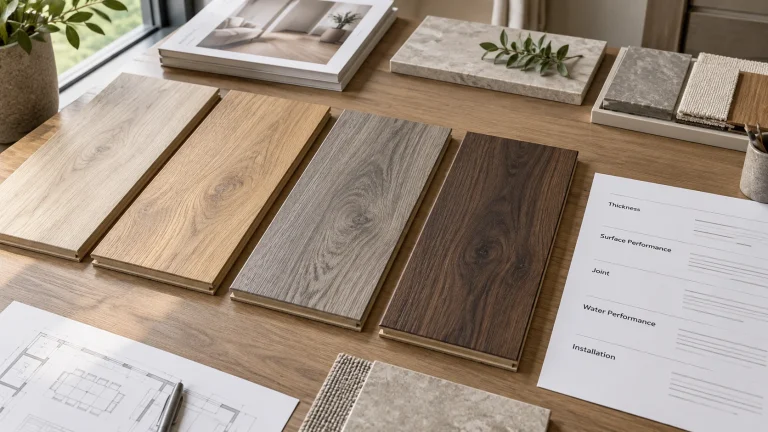
This is why an LVT catalog may include products that visually resemble:
- Hardwood flooring
- Oak planks
- Walnut
- Grey timber
- Marble
- Limestone
- Concrete
- Slate
- Textile-inspired surfaces
The visible design normally comes from a printed decorative layer within the vinyl flooring construction rather than from natural wood or stone.
LVT therefore allows designers to achieve a wide range of visual effects while using a resilient flooring system.

How Is LVT Flooring Constructed?
LVT is generally a layered resilient flooring product.
The exact construction varies between manufacturers and product systems, so buyers should always request the specification sheet for the exact model being quoted.
A typical flexible LVT product can include:
Surface Finish → Wear Layer → Decorative Film → Vinyl Body / Core → Backing
Each part performs a different function.
Surface Finish
The upper surface treatment contributes to the appearance and maintenance characteristics of the finished floor.
Different manufacturers may use different coatings or surface treatments.
Therefore, terms such as “easy-clean” or “commercial surface” should not replace the actual technical specification.
Wear Layer
The wear layer protects the printed decorative design from repeated surface abrasion.
This is one of the most important LVT specifications to compare.
The overall product thickness and the wear-layer thickness are not the same measurement.
For example, a 3 mm LVT product does not mean it has a 3 mm wear layer.
When requesting a quotation, ask the supplier to state:
Total Thickness + Wear-Layer Thickness
separately.
Decorative Film
The decorative layer creates the visible wood, stone or other design.
Modern LVT can reproduce a wide range of surfaces, but physical samples remain important.
Color displayed on:
- Phones
- Computer monitors
- PDF catalogs
- Website images
may differ from the finished production sample.
For large projects, the approved physical sample and product code should therefore form part of the purchase record.
Vinyl Body
The vinyl body gives flexible LVT its main physical form.
Unlike SPC, traditional flexible LVT does not rely on the same rigid stone-polymer core construction.
This affects the way the product feels, bends, installs and interacts with the substrate.
Backing
The underside of the flooring depends on the installation type.
Dry-back LVT is designed to be installed using a compatible flooring adhesive.
Self-adhesive products use an adhesive system already incorporated into the product backing.
These two systems should not be treated as interchangeable.

Main Types of LVT Flooring
One of the most important buying decisions is the installation system.
These should be evaluated separately.
Dry-Back LVT Flooring
Dry-back LVT is designed to be bonded to a prepared substrate using a compatible flooring adhesive.
The product itself does not rely on an SPC-style mechanical locking profile.
Because the flooring is relatively thin, substrate preparation becomes particularly important.
The finished result can reflect imperfections underneath if the base is not correctly prepared.
Typical project checks include:
- Subfloor flatness
- Smoothness
- Moisture condition
- Cracks or defects
- Primer requirements
- Adhesive compatibility
- Installation temperature
- Required curing time
The selected flooring and adhesive should be treated as one installation system rather than two unrelated products.
OKBuild Dry-Back LVT Examples
The current catalog includes wood-look dry-back planks measuring:
152.4 × 914.4 mm
with listed total thicknesses of:
1.5 mm / 2.0 mm / 3.0 mm.
The same catalog also includes stone-look tile formats measuring:
609.6 × 609.6 mm
with thickness options of:
2.0 mm / 2.5 mm / 3.0 mm
and surface descriptions including Plain, Slate and Coral.
This demonstrates how one LVT category can include both plank and square-tile formats.

Self-Adhesive LVT Flooring
Self-adhesive LVT uses an adhesive backing incorporated into the flooring product.
The protective backing is removed during installation so the flooring can be bonded onto the prepared surface.
This system can look straightforward, but a self-adhesive product should still not be installed over an unsuitable floor.
The substrate generally needs to be:
- Clean
- Smooth
- Stable
- Dry
- Free of dust, oil or loose contamination
The exact installation requirements should come from the approved product instructions.
Self-adhesive flooring can be useful where installation simplicity and low floor build-up are priorities, but the final selection should still reflect traffic, substrate conditions and intended service life.

LVT Flooring Thickness: What Does It Mean?
LVT is available in different thicknesses depending on product construction and installation system.
The current OKBuild dry-back catalog includes examples from approximately:
1.5 mm to 3.0 mm
for wood-look planks, while stone-look square formats are shown in:
2.0 mm, 2.5 mm and 3.0 mm.
However, buyers should not assume:
Thicker LVT = automatically better LVT.
Total thickness is only one part of the specification.
The selection should also consider:
- Wear layer
- Installation system
- Subfloor
- Traffic
- Floor-level coordination
- Adhesive
- Maintenance
- Project requirements
A thicker product may affect finished floor height, but surface performance depends on more than total product gauge.
LVT Wear Layer: Why It Matters
The wear layer deserves separate attention because it protects the printed design from everyday use.
When comparing LVT quotations, do not accept only:
2 mm LVT
or
3 mm commercial vinyl.
Ask for the actual wear-layer specification as well.
This is especially important for projects with:
- Repeated foot traffic
- Rolling office chairs
- Luggage
- Shopping carts
- Cleaning equipment
- Furniture movement
A bedroom and a busy retail entrance place very different demands on the floor.
The correct wear specification should therefore be selected according to the actual room and the technical documentation of the proposed product.
Does LVT Flooring Need a Perfectly Flat Subfloor?
No floor is literally perfect, but thin flexible LVT is strongly influenced by the surface underneath it.
This is particularly important for dry-back products.
Because the material is thin and bonded directly to the substrate, visible or physical irregularities underneath may affect the finished surface.
Before installation, check requirements for:
- Flatness
- Smoothness
- Moisture
- Cracks
- Old adhesive residue
- Dust
- Surface contamination
- Level changes
Do not use the decorative flooring itself as a method of correcting substrate defects.
Floor preparation should be completed first.
Main Advantages of LVT Flooring
LVT can provide several advantages when the correct product is matched to the project.
Wide Range of Designs
One major benefit is visual flexibility.
The same flooring category can reproduce both:
wood-look planks
and
stone-look tiles.
Low Floor Build-Up
Flexible dry-back LVT can be comparatively thin.
This can be useful where designers need to coordinate flooring with:
- Existing doors
- Thresholds
- Elevators
- Tile
- Carpet
- Stone
- Existing renovation floor levels
However, adhesive and any substrate preparation must also be included when calculating the finished build-up.
Individual Piece Replacement
A modular plank or tile format can support localized replacement when the installation system allows it.
This can be valuable in commercial projects where damaged areas need to be repaired without replacing the entire floor.
Replacement stock should still be retained from the approved production batch.
Wood and Stone Looks Without Natural Material
LVT can create a timber or stone appearance without using actual hardwood or natural stone.
This gives designers more flexibility when material appearance, thickness, maintenance and budget all need to be balanced.
What Are the Limitations of LVT Flooring?
LVT is not automatically the right floor for every room.
Subfloor Preparation Can Be Demanding
Thin flexible flooring does not hide significant defects underneath it.
For dry-back LVT, substrate preparation can be one of the most important parts of the complete installation.
Installation Quality Matters
An attractive product can still produce a poor finished floor if:
- The adhesive is incorrect
- The substrate contains excessive moisture
- The surface is contaminated
- Layout lines are inaccurate
- The floor is installed before the substrate is ready
The flooring product and installation process need to be evaluated together.
LVT Is Not Natural Wood or Stone
The surface can be highly realistic, but it remains a printed decorative floor.
Buyers seeking natural stone variation, natural timber grain or refinishing potential may prefer another flooring system.
Replacement Color Can Change Over Time
Design films and production batches may change.
Large commercial and residential projects should therefore consider storing spare material for future repairs.
LVT vs SPC Flooring: What Is the Difference?
LVT and SPC are closely related within the broader resilient flooring market, but traditional flexible LVT and rigid-core SPC should not be treated as the same construction.
A simplified comparison is:
| Factor | Flexible LVT | SPC Flooring |
|---|---|---|
| Main body | Flexible vinyl construction | Rigid composite core |
| Typical installation | Often glue-down; other systems also exist | Commonly click-lock |
| Floor build-up | Can be relatively thin | Usually thicker |
| Subfloor influence | Thin material can show substrate irregularities | Rigid core is less flexible but still requires proper substrate |
| Backing | Depends on product | May include attached backing such as IXPE |
| Repair approach | Individual bonded pieces may be replaceable | Depends on click-floor layout and access |
| Typical visual formats | Wood-look planks and stone-look tiles | Wood-look planks, tile-like and other formats |
Neither flooring type is universally superior.
The right choice depends on:
- Project use
- Traffic
- Subfloor
- Installation schedule
- Floor height
- Acoustic requirements
- Replacement strategy
- Maintenance
For a detailed explanation of SPC construction, layers and 4 mm / 6 mm / 7 mm examples, see OKBuild’s SPC Flooring Guide.
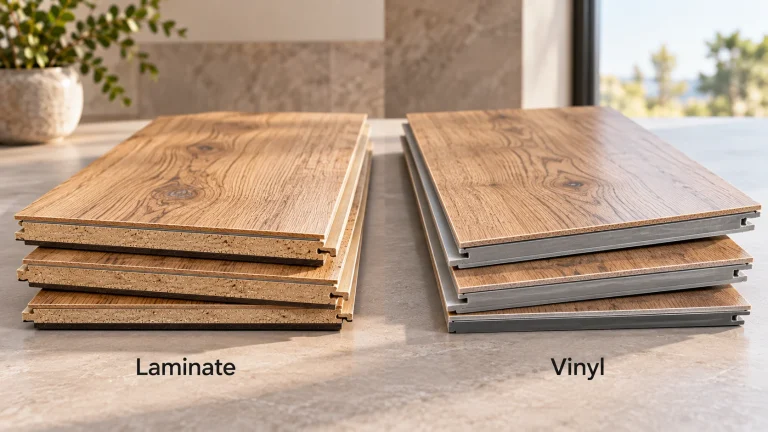
LVT vs Laminate Flooring
LVT and laminate can both reproduce wood-style interiors, but their constructions differ.
LVT is a resilient vinyl-based flooring system.
Laminate commonly uses a wood-based core beneath its decorative surface system.
That difference can affect:
- Moisture behavior
- Floor feel
- Thickness
- Subfloor interaction
- Installation
- Repair
- Acoustics
Where Can LVT Flooring Be Used?
The correct application depends on the actual product specification.
Residential Interiors
LVT can be considered for:
- Living rooms
- Bedrooms
- Apartments
- Home offices
- Selected kitchens
- Renovation projects
Thin products can be useful where existing floor heights restrict the available build-up.
Offices
LVT is commonly considered for commercial office zones where a hard, cleanable resilient floor is required.
Potential locations include:
- Reception areas
- Corridors
- Breakout zones
- Meeting areas
- Pantries
- Workspaces
For a broader office-material planning checklist, see OKBuild’s Office Fit-Out Materials Checklist.
Hotels
Hospitality projects may consider LVT for:
- Guestrooms
- Serviced apartments
- Selected corridors
- Extended-stay accommodation
- Other areas where a timber or stone appearance is required
The entire hotel should not automatically use one flooring material.
A lobby, corridor, bathroom, guestroom and restaurant may each need different flooring systems.
For broader hospitality flooring selection, see the Hotel Flooring Manufacturers & Suppliers Guide.
Retail
Retail floors need to consider foot traffic, maintenance, shop layout, replacement and rolling loads.
LVT can be considered in:
- Fashion stores
- Showrooms
- Reception areas
- Service zones
- Selected shopping environments
For whole-store material planning, see OKBuild’s Retail Fit-Out Materials Checklist.

LVT Flooring for Commercial Projects
Commercial LVT procurement involves more than choosing a design.
A contractor or developer may be purchasing hundreds or thousands of square meters.
At that scale, the project team should control:
- Product code
- Color
- Dimensions
- Total thickness
- Wear layer
- Installation method
- Adhesive
- Batch consistency
- Room or zone allocation
- Packing
- Spare stock
- Delivery sequence
A small specification error can become expensive when repeated across an entire project.
Dry-Back LVT and Adhesive Selection
When using dry-back LVT, the adhesive is part of the flooring system.
Do not assume that any general flooring adhesive is automatically suitable.
The installer should follow the approved product and adhesive requirements for the actual substrate and project conditions.
Replacement Stock
Commercial projects should consider retaining spare planks or tiles.
The amount depends on:
- Project size
- Number of designs
- Customization
- Expected maintenance
- Future availability
The objective is to make future localized repairs easier without relying on an identical decorative batch remaining available years later.
Batch and Color Control
Where one design covers multiple apartments, hotel rooms or retail zones, approved samples and production references should be clearly recorded.
Do not rely only on a generic color description such as:
Light Oak
or
Grey Wood.
Use exact model codes wherever possible.
How to Compare LVT Flooring Quotations
Two LVT quotations can look similar while describing materially different products.
Consider:
Supplier A:
3 mm LVT
Supplier B:
3 mm LVT
That does not prove they are equivalent.
The products may differ in:
- Wear layer
- Surface treatment
- Construction
- Installation method
- Adhesive requirement
- Dimensions
- Design
- Intended traffic
- Technical documentation
Before comparing unit prices, align the technical specification first.
What Should Buyers Check Before Ordering LVT Flooring?
Use the following checklist.
| Specification | What to Confirm |
|---|---|
| Product code | Exact approved model |
| Installation type | Dry-back, self-adhesive or other system |
| Dimensions | Length × width |
| Total thickness | Exact product thickness |
| Wear layer | Exact value and unit |
| Surface | Texture / embossing / finish |
| Decorative design | Approved color or pattern |
| Backing | Exact backing construction |
| Adhesive | Required system if glue-down |
| Subfloor | Flatness, moisture and preparation requirements |
| Application | Residential / commercial suitability |
| Technical documents | Required test documents for project/destination |
| Packaging | Pieces, m² and cartons |
| Batch control | Color / production reference |
| Spare stock | Future replacement allowance |
| Installation | Approved installation instructions |
For international projects, this checklist should ideally be completed before final price comparison, not after the purchase order has already been issued.
LVT Flooring Design Options
Wood-Look LVT
Wood-look products can reproduce:
- Pale timber
- Natural oak
- Warm brown
- Walnut-style tones
- Grey woods
- Dark timber
Stone-Look LVT
Stone-look products can reproduce:
- Marble
- Limestone
- Concrete
- Grey stone
- Dark stone
- Other mineral surfaces
This gives designers the option to use different visual languages without automatically switching to ceramic or natural stone.
How OKBuild Supports LVT Flooring Procurement
LVT flooring is often only one part of a larger building-material package.
Flooring needs to coordinate with:
- Doors
- Skirting
- Staircases
- Cabinets
- Wardrobes
- Wall panels
- Tile
- Stone
- Furniture
- Bathroom finishes
For example, a flooring thickness decision can affect:
- Door clearance
- Threshold height
- Skirting position
- Transitions to tile
- Furniture installation
- Finished floor level
Project sourcing can begin with:
- Architectural drawings
- Interior-design drawings
- Flooring schedules
- BOQ
- Room lists
- Product references
- Required technical specifications
The objective is to define the correct product and installation system before sampling, pricing and order confirmation.
Frequently Asked Questions
What Does LVT Stand for in Flooring?
LVT stands for Luxury Vinyl Tile.
The category includes tile-shaped and plank-shaped luxury vinyl flooring products.
Is LVT the Same as Vinyl Flooring?
LVT is a type of vinyl or resilient flooring.
However, “vinyl flooring” is a broader term that can include other constructions and formats.
Is LVT Flooring Available in Wood-Look Planks?
Yes.
The current OKBuild catalog includes dry-back wood-grain LVT in 152.4 × 914.4 mm plank format.
What Thickness Is LVT Flooring?
There is no single standard thickness.
Current OKBuild dry-back examples include 1.5 mm, 2.0 mm and 3.0 mm wood-look products, while square stone-look options include 2.0 mm, 2.5 mm and 3.0 mm thicknesses.
The appropriate specification depends on the product, installation system and intended use.
Is Thicker LVT Always Better?
No.
Total thickness is only one specification.
Wear layer, substrate, installation system, surface construction and traffic conditions also need to be evaluated.
What Is Dry-Back LVT?
Dry-back LVT is a flooring product intended to be bonded to the prepared subfloor using a compatible adhesive.
It does not use the same rigid click-lock construction as SPC.
What Is Self-Adhesive LVT?
Self-adhesive LVT has an adhesive backing incorporated into the product.
The protective backing is removed during installation before the flooring is bonded to a suitable prepared surface.
Is LVT Better Than SPC?
Neither is universally better.
Flexible LVT can offer a thin bonded flooring solution, while SPC uses a rigid core and is commonly supplied as a thicker click-lock system.
The right choice depends on floor height, substrate, traffic, installation, maintenance and project requirements.
See the SPC Flooring Guide for a detailed explanation of SPC.
Is LVT Suitable for Commercial Projects?
Selected LVT products can be considered for offices, hotels, retail and other commercial interiors.
The exact product specification, wear layer, substrate, adhesive and required documentation should be confirmed for the intended application.
What Should I Send a Supplier for an LVT Flooring Quotation?
Provide:
- Project location
- Required area or quantity
- Room type
- Architectural drawings
- Flooring schedule
- Preferred design
- Required installation system
- Thickness where already specified
- Traffic or performance requirements
- Required technical documentation
- Delivery destination
This helps the supplier quote a defined LVT system instead of a generic vinyl floor.
Final
LVT flooring can provide a flexible combination of:
design choice + relatively low floor build-up + modular plank or tile formats + multiple installation systems.
However, “LVT flooring” is not a complete specification.
A reliable buying decision should consider:
Application → LVT Type → Wear Layer → Total Thickness → Subfloor → Adhesive / Installation System → Traffic → Batch Control → Documentation → Replacement Plan
This becomes especially important in hotels, offices, retail projects, apartments and other developments where a flooring specification may be repeated across hundreds or thousands of square meters.
Rather than asking only:
“How much is your LVT per square meter?”
first confirm exactly which construction is being compared.
For projects involving multiple flooring types, review OKBuild’s Commercial Flooring Materials Guide.
For rigid-core flooring comparisons, see the newly published SPC Flooring Guide.
For project-specific LVT selection, BOQ review and quotation, contact OKBuild with your drawings and flooring requirements.