SPC Flooring Guide: Layers, Thickness, Wear Layer, Pros, Cons & Buying Tips

- 2026/10/2
- By Colin Pun, OKBuild Project Manager
Table of Contents
ToggleSPC flooring has become a widely considered option for houses, apartments, offices, hotels and other residential or commercial interiors.
Its appeal comes from a combination of rigid-core construction, broad design choices, click-lock installation options and practical maintenance.
However, choosing SPC flooring should involve more than selecting a wood color from a catalog.
Two SPC floors that look almost identical can have different total thicknesses, wear layers, backing systems, locking profiles and intended applications. Those differences can affect installation, finished floor height, acoustics, surface durability and long-term replacement planning.
For buyers, developers and contractors, the more useful question is therefore not simply:
“Is SPC flooring good?”
It is:
“Which SPC flooring specification is appropriate for this room and this project?”
This guide explains SPC flooring construction, thickness, wear layer, advantages, limitations and the specifications buyers should check before ordering.
If you are still deciding between SPC, LVT, tile, stone, engineered wood or other flooring systems, start with OKBuild’s Commercial Flooring Materials Guide.
SPC Flooring at a Glance
Before looking at each specification in detail, the following table summarizes the basic characteristics buyers usually need to understand.
| Item | SPC Flooring |
|---|---|
| Core | Rigid SPC composite core |
| Appearance | Commonly wood-, stone- or other printed designs |
| Surface protection | Wear layer plus surface coating |
| Installation | Commonly available with click-lock systems |
| Backing | May be supplied with or without attached backing |
| Formats | Planks, wider boards and selected tile-like formats |
| Thickness | Varies by product; current OKBuild catalogs include 4 mm, 6 mm and 7 mm examples |
| Applications | Residential and selected commercial interiors |
| Key buying factors | Wear layer, total thickness, core, backing, locking system, substrate and intended use |
The important point is that SPC flooring is a product category, not one standardized specification.
What Is SPC Flooring?
SPC commonly refers to Stone Plastic Composite flooring. The term Stone Polymer Composite is also used in some markets.
It belongs to the rigid-core resilient flooring category and is built around a relatively rigid composite core underneath the decorative surface.
Unlike solid wood flooring, the visible timber pattern normally comes from a printed decorative film rather than a piece of natural timber.
Similarly, stone-look SPC can reproduce marble, concrete or stone aesthetics without using natural stone or porcelain tile.
A typical SPC floor may include:
- Surface coating
- Transparent wear layer
- Decorative film
- Rigid SPC core
- Optional attached backing
- Click-lock edge profile
The exact construction varies by product.
That variation matters because the words “SPC flooring” alone do not provide enough information for a project buyer to compare two quotations accurately.

How Is SPC Flooring Constructed?
SPC flooring cannot be evaluated only by looking at the visible wood or stone pattern.
A typical construction can be simplified as:
Surface Coating → Wear Layer → Decorative Film → SPC Core → Optional Backing
Surface or UV Coating
The upper coating forms part of the surface-protection system.
Depending on the product, it can contribute to surface finish, cleaning behavior and resistance to everyday staining.
It should not be confused with the wear layer underneath.
Wear Layer
The transparent wear layer helps protect the decorative surface against repeated abrasion.
This is one of the most important specifications to check when comparing SPC flooring.
A common mistake is to assume:
Thicker flooring = thicker wear layer.
That is not necessarily true.
One product may use a thicker core or additional attached backing while retaining a similar wear-layer specification.
A proper quotation should therefore state:
Total Thickness + Wear Layer + Core Construction + Attached Backing
separately.
Decorative Film
The decorative film creates the visible design of the flooring.
SPC collections can include:
- Light oak
- Natural timber
- Walnut tones
- Grey wood
- Dark timber
- Herringbone-style visuals
- Stone-inspired patterns
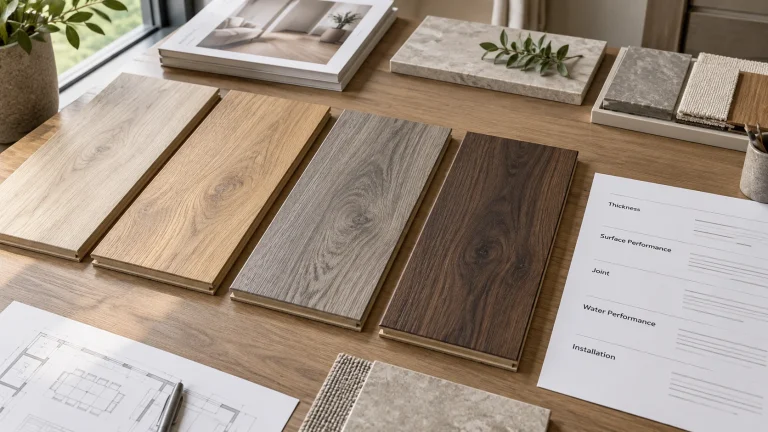
Final color approval should ideally use a physical sample rather than only a photograph or computer screen.
SPC Rigid Core
The rigid composite core is the defining structural component of SPC flooring.
Its rigidity differentiates SPC from more flexible resilient-flooring constructions.
However, rigidity does not eliminate the need for proper substrate preparation.
An unsuitable or excessively uneven floor can still affect the joints, stability and final appearance.
Attached Backing
Some SPC products include an attached backing layer such as IXPE.
This backing becomes part of the total floor build-up and may contribute to walking feel and acoustic performance.
Buyers therefore need to distinguish between:
SPC core thickness
and
total product thickness including backing.

SPC Flooring Thickness: Is Thicker Always Better?
No.
SPC flooring is available in different overall thicknesses, but thickness should not be treated as a single measure of product quality.
Current OKBuild catalog examples include:
- 4 mm
- 6 mm
- 7 mm
Different thicknesses can affect floor build-up, plank rigidity and coordination with adjacent construction.
This becomes important around:
- Door clearances
- Skirting
- Thresholds
- Transition strips
- Stairs
- Tile junctions
- Stone flooring
- Finished floor levels
If SPC flooring meets another flooring material, the total build-up needs to be coordinated rather than comparing only the face finish. For tile-related dimension planning, see OKBuild’s Tile Sizes Guide.
4 mm SPC Flooring
Current OKBuild catalog ranges include 1220 × 184 × 4 mm SPC planks.
A 4 mm product may suit some applications, but the correct choice depends on the complete system, substrate and intended use.
6 mm SPC Flooring
Some products in the current catalog are identified as:
5 mm SPC + 1 mm IXPE = 6 mm total thickness.
Examples are shown at approximately 1225 × 185 × 6 mm.
This illustrates why buyers should ask whether quoted thickness includes an attached backing.
7 mm SPC Flooring
Current catalog examples also include:
5.5 mm SPC + 1.5 mm IXPE = 7 mm total thickness
at approximately 1240 × 182 mm.
The catalog also contains other 7 mm SPC formats.
A 7 mm product is not automatically better than every 4 mm or 6 mm product.
The intended room, surface construction, backing, click system and project requirements still need to be considered.

What Is the SPC Flooring Wear Layer?
The wear layer and the SPC core perform different functions.
The core provides the rigid structure.
The wear layer helps protect the decorative surface against repeated everyday abrasion.
When comparing quotations, buyers should request the exact wear-layer specification rather than relying only on marketing descriptions such as:
“heavy duty”
or
“commercial grade.”
Wear-layer specifications may also be expressed in different units depending on the supplier and market.
Make sure the values are being compared on the same basis.
The correct wear specification should reflect anticipated traffic.
A private bedroom, serviced apartment, office, hotel guestroom and busy retail interior do not create identical flooring conditions.
For commercial procurement, the specification should therefore be confirmed for the actual proposed product.
Is SPC Flooring Waterproof?
SPC flooring is frequently marketed as waterproof because its rigid composite core has high resistance to water.
However, this statement needs to be interpreted carefully.
A water-resistant flooring material does not automatically make the complete installed floor assembly waterproof.
The installation also includes:
- Plank joints
- Perimeter gaps
- Thresholds
- Transitions
- Skirting
- Subfloor
- Walls
- Adjacent finishes
Water can interact with these areas even when the core itself is not readily damaged by moisture.
SPC flooring should therefore not be treated as a substitute for a dedicated waterproofing system where the building assembly requires one.
Bathrooms and other wet areas may also have separate requirements for waterproofing, drainage, slip resistance and installation.
Main Advantages of SPC Flooring
SPC can offer several practical advantages when the selected specification matches the project.
Wide Design Selection
One of the main benefits is visual flexibility.
SPC flooring can reproduce:
- Light woods
- Warm oak
- Grey timber
- Walnut effects
- Dark wood
- Stone looks
- Contemporary neutral surfaces
This allows flooring to coordinate with cabinets, wardrobes, doors, furniture and wall finishes without requiring natural timber throughout the building.
Rigid-Core Construction
The rigid core provides a relatively stable plank construction compared with more flexible resilient flooring.
This can be useful where a rigid click-lock floor is preferred.
However, the substrate must still meet the requirements of the selected flooring system.
Click-Lock Installation Options
Many SPC products use interlocking edges.
Where site conditions are suitable, this can support relatively efficient floating-floor installation.
Installation procedures should always follow the requirements of the approved flooring model.
Multiple Sizes and Formats
SPC is not limited to one conventional timber plank size.
- 1220 × 184 × 4 mm
- 640 × 128 × 4 mm
- 620 × 310 × 4 mm
- 1220 × 182 × 7 mm
- 610 × 610 × 7 mm
- etc..
What Are the Limitations of SPC Flooring?
SPC is not automatically the correct flooring material for every application.
Subfloor Quality Still Matters
The rigid core sometimes creates the misconception that SPC can simply cover any uneven substrate.
That should not be assumed.
The floor underneath still needs to meet the installation requirements of the selected system.
Excessive unevenness can contribute to movement, joint stress or an unsatisfactory finished surface.
Acoustic Performance Depends on the Complete System
An attached backing such as IXPE can form part of the floor assembly.
However, an attached pad alone does not prove that a particular room-to-room or floor-to-floor acoustic requirement will be achieved.
Apartment buildings, hotels and other multi-story projects may require project-specific acoustic documentation.
SPC Is Not Natural Timber
Modern decorative films can reproduce convincing wood patterns, but SPC does not have the same material characteristics as genuine timber.
Projects that prioritize natural grain variation, timber aging or refinishing potential may prefer engineered or solid wood.
Replacement Stock Needs Planning
Large projects should consider future replacement before installation begins.
Decorative-film production and colors may change over time.
For apartments, hotels or commercial projects, keeping spare cartons from the approved batch can simplify future repairs.

SPC Flooring vs LVT: What Is the Difference?
SPC and LVT sit within the broader resilient-flooring market, but their construction should not be treated as identical.
The defining characteristic of SPC is its rigid composite core.
LVT can use more flexible constructions and is also widely available in glue-down formats.
Depending on the products being compared, this can influence:
- Installation
- Walking feel
- Subfloor requirements
- Floor build-up
- Acoustic strategy
- Replacement method
Neither is universally better.
The choice should depend on how the room is used and how the flooring needs to be installed and maintained.
SPC Flooring vs Laminate Flooring
SPC and laminate flooring can look very similar when both use wood-inspired surfaces.
Their construction, however, is different.
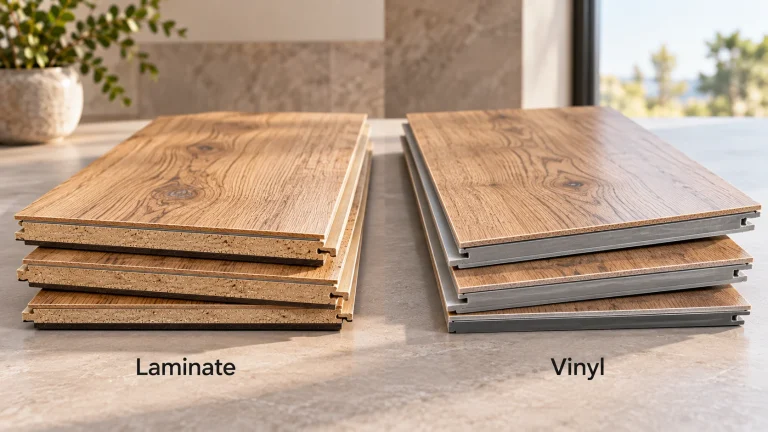
SPC uses a rigid composite core, while laminate flooring commonly uses a wood-based core beneath its decorative and protective surface layers.
This can influence:
- Moisture behavior
- Walking feel
- Acoustics
- Product thickness
- Installation
- Surface characteristics
The correct comparison therefore goes beyond the visible sample.
Two oak-look floors are not necessarily technically interchangeable.
Buyers should compare the complete product construction, intended application, wear requirements, substrate and installation system.
Where Can SPC Flooring Be Used?
SPC flooring can be considered for a range of residential and selected commercial interiors, depending on the exact specification.
Living Rooms and Bedrooms
Wood-look SPC is frequently considered where an interior needs the appearance of timber with a rigid resilient-floor construction.
It can work across bedrooms, living rooms and open residential spaces where the selected product suits the project requirements.
Apartments
Apartment projects often repeat the same flooring across multiple units.
That makes consistency, packing, installation details and replacement stock particularly important.
A small mistake in product selection can be repeated across dozens or hundreds of rooms.
Offices
SPC can be considered for selected office spaces.
For broader office material coordination, including resilient flooring, carpet tile, doors, ceilings and wall systems, see OKBuild’s Office Fit-Out Materials Checklist.
For office flooring, evaluate more than appearance.
Consider:
- Foot traffic
- Office chairs
- Cleaning
- Acoustics
- Subfloor
- Maintenance
- Replacement
Hotels
SPC may be considered for guestrooms, serviced apartments and selected hospitality interiors.
However, one hotel does not necessarily need one floor material throughout the building.
Guestrooms, corridors, bathrooms, restaurants and lobbies may require completely different flooring systems.
For a broader hospitality comparison, see OKBuild’s Hotel Flooring Manufacturers & Suppliers Guide.
Retail and Commercial Interiors
Selected SPC products may also be considered for retail and other commercial interiors.
The exact product should be checked for the anticipated traffic, maintenance method and project requirements rather than assuming every SPC floor is suitable for commercial use.

SPC Flooring for Apartments, Hotels and Commercial Projects
Large projects create procurement issues that are less important when buying flooring for one residential room.
A developer ordering several thousand square meters may need to control:
- Approved product code
- Approved color
- Batch consistency
- Carton labeling
- Installation zone
- Flooring direction
- Transition details
- Spare material
- Replacement stock
- Delivery sequencing
A sample may look correct during approval, but that does not guarantee that the final quantity will arrive, install and coordinate correctly across the entire project.
Batch and Color Consistency
When the same flooring is being installed across many rooms, the approved reference should be clearly documented.
Production batches should be coordinated according to the project requirements.
Spare Flooring
For larger developments, retaining replacement stock can be useful.
This is particularly relevant when one floor design is repeated across many apartments or guestrooms.
Floor Transitions
Flooring often meets:
- Tile
- Stone
- Carpet
- Stairs
- Bathroom flooring
- Entrance flooring
The finished levels should therefore be coordinated during material selection rather than left until installation.
Delivery and Installation Sequence
Flooring may need to arrive at a different stage from cabinetry, doors or furniture.
For international projects, quantity planning and delivery sequencing can therefore be as important as selecting the surface finish itself.
Subfloor Preparation Still Matters
One of the most common flooring mistakes is focusing entirely on the visible product.
SPC sits on a substrate.
That substrate influences the complete installation.
Before installation, the responsible project team should verify the required conditions for:
- Flatness
- Moisture
- Cleanliness
- Stability
- Level changes
- Expansion requirements
- Door thresholds
- Adjacent flooring
A rigid plank should not be expected to correct an unsuitable substrate.
Final requirements should follow the installation instructions for the approved flooring model.
Does SPC Flooring Need Underlayment?
There is no universal answer for every SPC product.
Some models already include attached backing.
Others may use different floor assemblies.
For example, current OKBuild catalog products include:
5 mm SPC + 1 mm IXPE
and
5.5 mm SPC + 1.5 mm IXPE.
If the flooring already includes an attached backing, another underlayment should not automatically be added without checking the product specification.
In apartment, hotel and commercial projects, acoustic requirements should also be evaluated separately from the simple presence of an attached pad.
SPC Flooring Design Options
SPC flooring is not limited to traditional medium-brown wood.
Light Wood SPC
Pale oak and lighter timber tones can suit contemporary apartments and interiors that need a brighter visual effect.
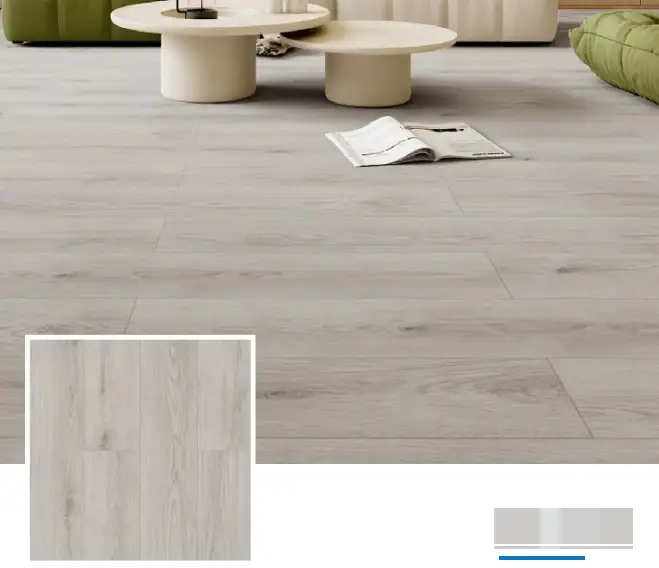
Grey Wood SPC
Grey flooring can coordinate with neutral furniture, black or white joinery and contemporary commercial interiors.
Warm and Dark Wood SPC
Warm oak and darker walnut-inspired designs can create stronger contrast in living rooms, hotels and more traditional interiors.
Stone-Look SPC
Some SPC flooring uses stone-inspired decorative films instead of timber patterns.
This can create a different visual language while retaining the underlying SPC construction.
Physical samples should still be approved because screen colors and catalog photography may not reproduce the final product exactly.
What Should Buyers Check Before Ordering SPC Flooring?
A useful quotation should contain enough technical information to compare products on an equivalent basis.
| Specification | What to Confirm |
|---|---|
| Product code | Exact approved model |
| Dimensions | Length × width |
| Total thickness | Complete finished thickness |
| SPC core | Core construction or core thickness where specified |
| Wear layer | Thickness and measurement unit |
| Surface | Finish and embossing if applicable |
| Decorative film | Exact approved color or pattern |
| Edge | Edge treatment if relevant |
| Locking system | Exact click profile |
| Backing | Material and thickness |
| Intended use | Application suitability |
| Documentation | Required product/test documents |
| Packing | Pieces, m² and cartons |
| Spare stock | Replacement quantity |
| Installation | Subfloor and installation requirements |
This information is especially important when comparing prices.
For example:
Supplier A: SPC flooring — 6 mm
Supplier B: SPC flooring — 6 mm
The two quotations look identical.
They may not be.
One product could have a different core thickness, wear layer, backing construction, locking profile or surface system.
Therefore, price per square meter should only be compared after the technical specifications have been aligned.
How OKBuild Supports SPC Flooring Procurement
For a complete building project, flooring rarely exists in isolation.
It has to coordinate with:
- Doors
- Skirting
- Staircases
- Kitchen cabinets
- Wardrobes
- Wall panels
- Tiles
- Stone
- Furniture
- Bathroom finishes
OKBuild’s wider product range includes flooring and staircase systems alongside other building and interior materials. OKBuild Products
SPC flooring sourcing can begin from:
- Architectural plans
- Flooring schedules
- BOQ
- Room lists
- Interior drawings
- Reference samples
- Performance requirements
The objective is to narrow the product specification before final quotation, sampling and order confirmation.

Frequently Asked Questions
What Does SPC Stand for in Flooring?
SPC commonly stands for Stone Plastic Composite. Stone Polymer Composite is another term used for the same general rigid-core flooring category in some markets.
Is SPC Flooring the Same as Vinyl Flooring?
SPC belongs to the broader resilient or vinyl-flooring market, but it is specifically characterized by its rigid composite core.
Not every vinyl flooring product is SPC.
Is Thicker SPC Flooring Always Better?
No.
Total thickness is only one specification.
Wear layer, core construction, backing, locking system, substrate and intended application also need to be considered.
What Thickness Does SPC Flooring Come In?
SPC flooring is manufactured in different thicknesses.
Current OKBuild catalog examples include 4 mm, 6 mm and 7 mm options, including products with attached IXPE backing.
The correct thickness depends on the complete flooring system and project requirements.
Is SPC Flooring Good for Commercial Projects?
Selected SPC products can be considered for offices, apartments, hospitality spaces, retail interiors and other commercial applications.
Commercial suitability should be confirmed for the exact product rather than assumed simply because it is described as SPC.
Does SPC Flooring Need Underlayment?
It depends on the product.
Some SPC flooring already includes attached backing such as IXPE.
Check the complete product construction before adding another underlayment.
Is SPC Flooring Suitable for Bathrooms?
The SPC core itself generally has strong resistance to water, but bathroom flooring involves more than the plank material.
Waterproofing, drainage, joints, slip requirements, substrate conditions and local construction requirements should also be considered.
What Is More Important: SPC Thickness or Wear Layer?
They perform different functions.
Total thickness describes the overall floor construction.
The wear layer forms part of the surface-protection system.
Neither should be evaluated alone.
What Should I Send a Supplier for an SPC Flooring Quotation?
Provide as much of the following as possible:
- Project location
- Required quantity
- Floor area
- Room type
- Architectural or interior drawings
- Flooring schedule
- Preferred color or reference
- Required thickness where already specified
- Performance requirements
- Required test or certification documentation
- Delivery destination
This allows the supplier to quote against a defined project requirement instead of simply offering a generic SPC floor.
Final Thoughts
SPC flooring can be a practical choice when a project needs a rigid resilient flooring system, broad decorative options and efficient installation possibilities.
But “SPC flooring” is a category, not a complete specification.
A more reliable purchasing process considers:
Application → Construction → Wear Layer → Total Thickness → Core → Backing → Locking System → Subfloor → Documentation → Installation
That becomes especially important for apartments, hotels, offices, retail projects and large residential developments where one incorrect specification can be repeated across a large floor area.
Instead of asking only:
“What is your cheapest SPC flooring?”
provide the supplier with the room type, quantity, drawings and performance requirements so that products can be compared on a defined technical basis.
For projects involving several flooring materials, review OKBuild’s Commercial Flooring Materials Guide.
For project-specific product selection, BOQ review and quotation, contact OKBuild with your drawings and flooring requirements.