Waterproof Laminate Flooring: What Buyers Should Check Before Choosing

- 2026/10/5
- By Colin Pun, OKBuild Project Manager
Table of Contents
ToggleWaterproof laminate flooring has become an attractive option for homeowners, developers and contractors who want the appearance and rigid feel of laminate while improving protection against everyday spills and moisture.
However, the word “waterproof” needs to be interpreted carefully.
Laminate flooring is a complete system involving:
surface + joints + edges + core + backing + installation.
A water-resistant surface alone does not guarantee that moisture can never reach the core, and a product marketed as waterproof does not automatically make an entire kitchen, bathroom or commercial floor assembly waterproof.
For buyers, the more useful questions are:
- What part of the flooring system is designed to resist water?
- How are the joints and edges protected?
- What happens if water remains on the surface?
- What testing supports the product claim?
- Which rooms are permitted?
- What installation conditions must be followed?
- What does the warranty actually cover?
Understanding these points makes it much easier to compare laminate products accurately.
For a broader overview of laminate construction, thickness and AC ratings, see OKBuild’s Laminate Flooring Guide.

Waterproof Laminate Flooring at a Glance
| Item | What Buyers Should Know |
|---|---|
| Main construction | Laminate commonly uses a wood-fiber-based core |
| Water protection | Depends on surface, joints, edges, core and installation |
| Waterproof claim | Must be checked against the exact product documentation |
| Water-resistant claim | Also requires verification of actual test and use conditions |
| Vulnerable areas | Joints, exposed edges, perimeter details and damaged surfaces |
| Installation | Can strongly influence water performance |
| Kitchens | Possible with suitable products and correct installation |
| Bathrooms | Product-specific; building waterproofing remains separate |
| Testing | Review relevant water-resistance or surface-swell information |
| Buying priority | Verify the exact model rather than relying on the label alone |
The key point is that water resistance is a system property, not simply a marketing word printed on the carton.
Is Laminate Flooring Really Waterproof?
Not all laminate flooring offers the same water performance.
Traditional laminate commonly uses a wood-fiber-based core beneath the decorative and protective surface layers.
The upper surface can handle normal cleaning and short-term exposure in many products, but moisture becomes more problematic when it reaches:
- Plank joints
- Cut edges
- Perimeters
- Damaged surfaces
- The underside of the flooring
For this reason, buyers should evaluate the exact flooring system instead of assuming that all laminate products perform the same around water.
Why the Word “Waterproof” Needs Verification
The terms waterproof and water-resistant are not always used as standardized performance classes in laminate flooring.
In practice, both can describe resistance to surface water exposure, while the actual level and conditions of protection vary by product.
That means a product labeled “waterproof” should not automatically be interpreted as:
Water can remain anywhere on the floor indefinitely without consequences.
It also does not mean:
The flooring replaces a bathroom waterproofing membrane.
The actual performance depends on the complete product specification, testing, installation requirements and warranty conditions.
Waterproof vs Water-Resistant Laminate Flooring
The two terms are often used differently between manufacturers, so buyers should not assume that one always represents a fixed technical level above the other.
A better approach is to compare what each product has actually been designed and tested to do.
| Claim | Do Not Assume | What to Verify |
|---|---|---|
| Water-resistant | Every product has the same exposure limit | Test method, exposure conditions, joints, edges and warranty |
| Waterproof | Unlimited water exposure or wet-room waterproofing | Test method, permitted rooms, installation and warranty |
| Either term | The label alone defines real performance | Exact product data and supporting documentation |
Instead of asking only:
“Is this laminate waterproof?”
a better question is:
“What water exposure has this exact product been designed and tested to resist?”

How Laminate Flooring Improves Water Resistance
Improved water performance normally depends on several components working together rather than one single feature.
Protective Top Surface
The upper surface acts as the first barrier against everyday spills.
It helps prevent moisture from immediately reaching the decorative layer and core.
However, water sitting on the center of a plank is usually less problematic than water reaching a joint, exposed edge or damaged area.
Tight Locking System
The joint between two laminate planks is one of the most important areas in the flooring system.
A well-designed locking profile can help reduce the opportunity for surface water to penetrate between adjacent planks.
Correct assembly during installation is equally important.
Treated Edges
Some moisture-resistant laminate products use treatments around plank edges or bevels.
These treatments are intended to reduce moisture penetration at vulnerable interfaces.
Edge treatment should be evaluated together with the locking system rather than as a standalone feature.
Enhanced Core Board
Many laminate floors use a wood-fiber-based core.
Some products use core formulations or treatments intended to improve moisture resistance.
However, the term HDF alone does not prove a specific level of water performance.
Core density, formulation and manufacturing method can differ between products.

What Happens When Water Reaches the Laminate Core?
This is one of the most important issues to understand when evaluating laminate flooring.
A typical laminate core contains wood fiber.
If an unsuitable core absorbs excessive moisture, dimensional changes can occur.
Possible symptoms include:
- Raised plank edges
- Swollen joints
- Cupping
- Surface distortion
- Locking-joint damage
- Permanent dimensional change
Once significant swelling has occurred, simply drying the surface may not return the plank to its original condition.
That is why joint protection, edge treatment and correct installation matter.
Surface Water and Subfloor Moisture Are Different Problems
A floor can be exposed to moisture from two directions:
from above
and
from below.
A product designed to resist surface spills does not automatically solve moisture coming from:
- Concrete slabs
- Damp subfloors
- Plumbing leaks
- Ground moisture
- Building-envelope problems
- Poor vapor control
This distinction is especially important in basements, ground floors and projects installed over concrete.
Subfloor conditions should therefore be checked before installation.
How Should Waterproof Laminate Claims Be Verified?
For a project, the water-performance claim should be connected to the exact product being quoted.
Check the Exact Product Model
Avoid accepting a generic statement such as:
“Our laminate is waterproof.”
Confirm whether the claim applies to the exact:
- Product code
- Core
- Thickness
- Lock profile
- Edge treatment
- Surface system
being offered.
Ask What the Water Claim Covers
Find out whether the claim relates to:
- Top-surface exposure
- Joint resistance
- Surface swelling
- Edge protection
- Leakage through assembled joints
- A defined installation system
Different test methods evaluate different aspects of flooring performance.
Check the Test Basis
For project procurement, request the relevant documentation supporting the product’s water-resistance claim.
Useful information may include:
- Test method
- Test conditions
- Results
- Product identification
- Applicable standard
- Laboratory information where required
The important point is not how many certificates a supplier can provide.
The documentation must apply to the exact product being purchased.
Read the Installation Requirements
A laminate product may offer good water resistance while still requiring specific:
- Expansion gaps
- Perimeter details
- Sealants
- Underlayment
- Subfloor preparation
- Transition details
Ignoring installation requirements can compromise the complete system.
Read the Warranty Conditions
Check specifically for:
- Permitted rooms
- Exposure limitations
- Flood exclusions
- Plumbing-leak exclusions
- Installation requirements
- Cleaning restrictions
- Commercial-use conditions
A headline warranty period does not explain every type of water exposure that is covered.

Where Can Waterproof Laminate Flooring Be Used?
Room suitability depends on the exact product specification and the way the floor is installed.
Kitchens
Selected water-resistant or waterproof-rated laminate products can be considered for kitchens when the product is approved for that application.
Kitchen floors may encounter:
- Small spills
- Wet cleaning
- Dishwasher leaks
- Refrigerator condensation
- Sink-area moisture
- Plumbing connections
The greatest risk is often not one small spill that is cleaned quickly.
It is water reaching a joint, perimeter or underside and remaining unnoticed.
For kitchen projects, check:
- Joint protection
- Perimeter requirements
- Appliance areas
- Sink and dishwasher zones
- Cleaning method
- Product warranty
A suitable product still requires appropriate installation.
Bathrooms
Bathrooms require more caution.
Some laminate products may be approved for certain bathroom applications, while others may not be.
Even when the flooring itself offers strong surface-water resistance, bathrooms also involve:
- Shower water
- Bathtub overflow
- Plumbing penetrations
- Floor drains
- Wall-floor junctions
- Waterproof membranes
- Slip resistance
These are building-system issues rather than flooring-surface issues alone.
A waterproof-rated laminate floor should therefore not be treated as a replacement for required wet-area waterproofing.
Laundry Rooms and Entrances
Laundry rooms and entrances can expose flooring to:
- Wet footwear
- Washing-machine connections
- Umbrellas
- Cleaning water
- Dirt and grit
Improved water resistance can be useful, but abrasion resistance, joint design and installation details still need to suit the application.

Waterproof Laminate vs SPC and LVT Flooring
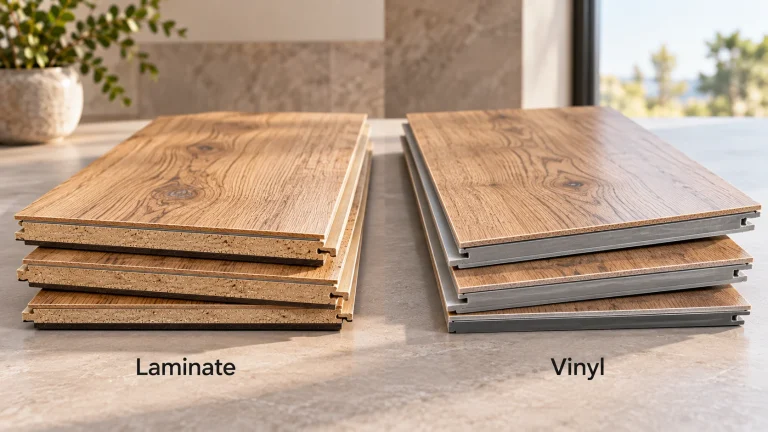
Laminate, SPC and LVT can all produce convincing wood-look surfaces, but their internal constructions are different.
| Factor | Water-Resistant Laminate | SPC Flooring | Flexible LVT |
|---|---|---|---|
| Main body | Commonly wood-fiber-based core | Rigid composite core | Flexible vinyl-based body |
| Decorative surface | Printed | Printed | Printed |
| Water behavior | Product-dependent | Core itself is not wood-fiber based; complete system still matters | Vinyl-based construction; complete installation still matters |
| Typical installation | Commonly floating click | Commonly floating click | Often glue-down; other systems exist |
| Floor feel | Typical rigid laminate feel | Rigid resilient-floor feel | More flexible |
| Key moisture checks | Core, joints, edges and installation | Joints, edges, backing and installation | Adhesive, substrate, joints and installation |
Waterproof Laminate vs SPC Flooring
Laminate commonly uses a wood-fiber-based core, while SPC uses a rigid composite core.
That difference affects how the two flooring systems respond to moisture.
However, SPC should not automatically be interpreted as an entire waterproof floor assembly simply because its core is not wood-fiber based.
Joints, edges, backing, transitions and installation still need to be considered.
For detailed SPC construction and thickness information, see OKBuild’s SPC Flooring Guide.
Waterproof Laminate vs LVT Flooring
Flexible LVT uses a vinyl-based construction rather than a wood-fiber laminate core.
This affects:
- Moisture behavior
- Flexibility
- Installation
- Floor build-up
- Subfloor requirements
Many dry-back LVT products are bonded directly to the substrate, while laminate is commonly installed as a floating floor.
For detailed LVT construction and installation types, see OKBuild’s LVT Flooring Guide.
Which One Is Better for Moisture-Prone Areas?
There is no universal winner for every project.
The selection should consider:
room conditions → expected water exposure → core construction → joints → installation → floor height → traffic → maintenance → documentation
rather than relying only on the material name.

Installation Details That Affect Water Performance
Even a well-designed laminate product can perform poorly if the installation system is unsuitable.
Subfloor Moisture
Before installation, the substrate should meet the flooring manufacturer’s moisture requirements.
This is particularly important over:
- Concrete
- Ground-level slabs
- Basements
- Newly completed construction
Water resistance from the top surface does not eliminate moisture risk from below.
Expansion Gaps
Floating laminate floors normally require movement allowance around fixed objects and room perimeters.
Do not eliminate required expansion space simply because the floor is described as waterproof.
Perimeter Details
Depending on the product and room, perimeter details can form part of the water-resistance strategy.
Follow the approved installation method rather than applying one generic sealing method to every laminate product.
Doorways and Transitions
Water can move between rooms.
Transitions around kitchens, bathrooms, entrances, balconies and laundry areas should therefore be coordinated with the flooring system and adjoining finishes.
Damaged Joints
A damaged click joint can affect more than appearance.
If water resistance depends partly on tight plank connections, broken or poorly assembled joints can create a potential moisture path.
Common Waterproof Laminate Flooring Buying Mistakes
Choosing Only by the Word “Waterproof”
A marketing term is not a complete technical specification.
Ignoring the Core
The core remains fundamental to laminate performance around moisture.
Ignoring Joints and Edges
Water frequently reaches flooring through interfaces rather than directly through the visible center of a plank.
Assuming AC Rating Means Waterproof
AC rating primarily relates to abrasion resistance.
A high AC rating does not automatically prove water resistance.
Using the Same Product Everywhere
A bedroom, kitchen, hotel room, entrance and commercial corridor have different risks.
Comparing Price Before Specifications
Two products can both be called waterproof laminate but still differ in:
- Core construction
- Thickness
- AC rating
- Locking system
- Edge treatment
- Water test results
- Warranty conditions
Price comparisons become meaningful only after the specifications have been aligned.
What Should Buyers Check Before Ordering Waterproof Laminate Flooring?
| Specification | What to Confirm |
|---|---|
| Product code | Exact model being purchased |
| Core | Core construction and moisture-resistant treatment |
| Thickness | Exact total thickness |
| AC rating | Abrasion classification where required |
| Surface | Protective finish and texture |
| Locking system | Exact joint profile |
| Edge treatment | Moisture-protection method if applicable |
| Water claim | Exact wording used for the product |
| Test basis | Relevant water, joint or swell documentation |
| Room suitability | Kitchen, bathroom, commercial use, etc. |
| Subfloor | Moisture and flatness requirements |
| Underlayment | Attached or separate |
| Perimeter | Required sealing and expansion details |
| Cleaning | Approved maintenance method |
| Warranty | Water-related exclusions and conditions |
| Spare stock | Future repair quantity |
For larger projects, this information should ideally be confirmed before final price comparison.
Waterproof Laminate Flooring for Commercial Projects
Commercial projects often involve larger floor areas and more complicated interfaces than a single residential room.
Possible applications may include:
- Apartments
- Hotel guestrooms
- Serviced apartments
- Offices
- Retail interiors
- Residential developments
The flooring specification should reflect both moisture exposure and traffic.
For example, a hotel guestroom may require consideration of:
- Bathroom entrances
- Housekeeping
- Luggage traffic
- Cleaning methods
- Replacement stock
An office may place more emphasis on:
- Chair movement
- Abrasion
- Acoustic requirements
- Subfloor conditions
Water resistance should therefore be evaluated together with the complete flooring performance specification.
For projects involving several flooring materials, see OKBuild’s Commercial Flooring Materials Guide.
How OKBuild Supports Flooring Procurement
Flooring is usually one part of a wider interior package.
Moisture-related flooring decisions can affect:
- Door thresholds
- Skirting
- Bathroom transitions
- Kitchen cabinetry
- Stone flooring
- Tile
- Stairs
- Wall finishes
- Furniture installation
OKBuild can work from architectural drawings, interior drawings, BOQs, flooring schedules, room lists, reference samples and technical requirements.
This allows flooring options to be compared against the actual project conditions before final sampling and quotation.
Frequently Asked Questions
Is Laminate Flooring Waterproof?
Not all laminate flooring offers the same water performance.
Water resistance varies according to product construction, joints, edges, core and installation.
Always verify the exact model.
What Is the Difference Between Waterproof and Water-Resistant Laminate?
The terms are not always used as standardized performance classes.
Both can refer to resistance against surface water exposure, so buyers should compare the exact product testing, installation requirements, permitted applications and warranty conditions.
What Makes Laminate Flooring More Water-Resistant?
Typical design approaches can include improved surface protection, tighter locking systems, treated edges and more moisture-resistant core construction.
Is Waterproof Laminate Good for Kitchens?
Selected products can be suitable for kitchens when the manufacturer permits the application and installation requirements are followed.
Water around sinks, dishwashers and appliances still needs proper management.
Can Waterproof Laminate Be Used in a Bathroom?
It depends on the exact product.
Even when laminate is approved for bathroom use, it does not replace required wet-area waterproofing, drainage or other building-system requirements.
Can Laminate Swell From Water?
Wood-fiber-based laminate cores can swell if excessive moisture reaches the core.
The degree of resistance depends on the exact product construction and exposure conditions.
Does AC5 Mean Laminate Is Waterproof?
No.
AC ratings primarily relate to abrasion resistance.
Water performance must be evaluated separately.
Is Waterproof Laminate Better Than SPC?
Not universally.
Laminate and SPC use different core constructions and can provide different floor feel, moisture behavior and installation characteristics.
Choose according to the actual room and project requirements.
Is Waterproof Laminate Better Than LVT?
Not universally.
LVT uses vinyl-based construction and often uses different installation systems.
The better choice depends on moisture conditions, substrate, floor height, traffic and maintenance requirements.
What Documents Should I Request From a Supplier?
For a project, useful documentation may include:
- Product specification
- Core information
- Water-resistance test information
- Installation instructions
- Room-use limitations
- Warranty conditions
- Relevant compliance documentation
The required documentation depends on the project and destination market.

Final Thoughts
Waterproof laminate flooring should be evaluated as a complete flooring system, not as one marketing word.
The most important factors are:
Surface → Joint → Edge → Core → Test Evidence → Installation → Room Conditions → Warranty
A product may provide strong resistance to everyday spills while still having defined installation and exposure limits.
That distinction matters particularly in kitchens, entrances, apartments, hotels and commercial projects where moisture exposure is more likely.
Before comparing prices, confirm exactly what the proposed flooring is designed to resist and under what conditions.
For a broader laminate overview, read OKBuild’s Laminate Flooring Guide.
For rigid-core and resilient flooring alternatives, see the SPC Flooring Guide and LVT Flooring Guide.
For project-specific flooring selection, BOQ review and quotation, contact OKBuild.