Sliding vs Hinged Wardrobe Doors: Which Is Better?

- 2026/9/26
- By Colin Pun, OKBuild Project Manager
Table of Contents
ToggleChoosing between sliding and hinged wardrobe doors is not only a style decision.
The way the doors open affects how much clear space you need in front of the wardrobe, how much of the interior you can access at one time, whether internal drawers work properly, what hardware is required and how the wardrobe behaves in daily use.
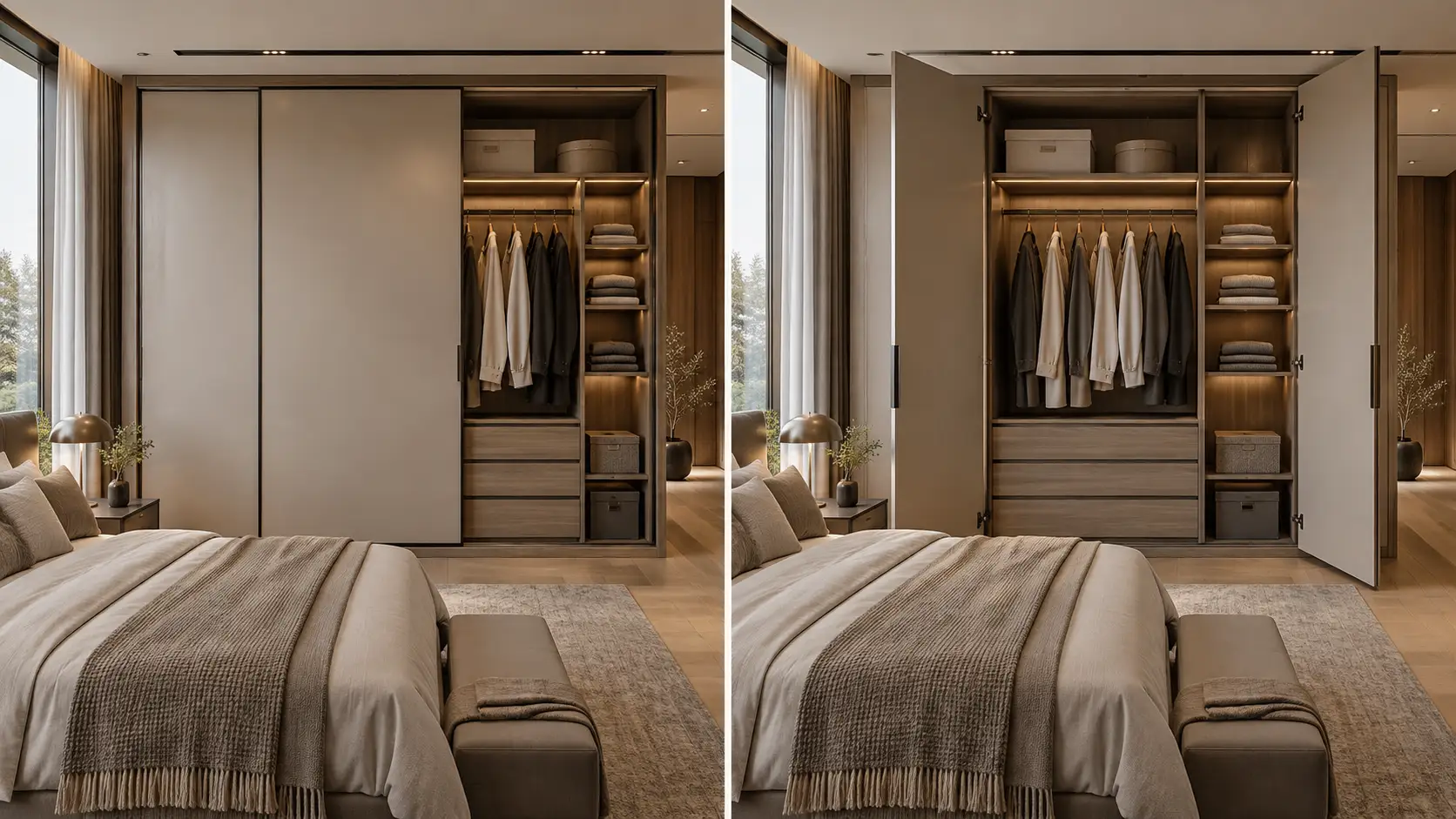
Sliding doors move sideways along a track, so they do not need a swing area in front of the wardrobe. Hinged doors open outward, usually giving more direct access to each storage section but requiring usable floor space in front.
Neither system is automatically better.
The right choice depends on the bedroom layout, wardrobe width, internal storage plan, door material and hardware system.
Sliding vs Hinged Wardrobe Doors: Quick Comparison
| Factor | Sliding Wardrobe Doors | Hinged Wardrobe Doors |
|---|---|---|
| Door movement | Slides sideways | Swings outward |
| Space in front | No door swing required | Requires swing clearance |
| Interior access | Usually part of wardrobe visible at one time | Individual sections can open directly |
| Internal drawers | Must align with accessible opening | Usually easier if doors open sufficiently |
| Door size | Often larger panels | Usually narrower individual leaves |
| Hardware | Tracks, rollers, guides, soft-close options | Hinges, mounting plates, soft-close options |
| Cleaning | Tracks and guides need attention | Hinges and door edges need inspection |
| Appearance | Clean, wide, contemporary panels | Flexible from modern to traditional |
| Mirror/glass doors | Common | Also possible |
| Best use | Tight bedroom layouts and wide wardrobe runs | Rooms with sufficient front clearance |
The most important point is this:
Choose the door system together with the wardrobe interior.
A door that looks good but blocks the drawers behind it is not a successful wardrobe design.
What Are Sliding Wardrobe Doors?
Sliding wardrobe doors move horizontally across the front of the wardrobe.
Depending on the system, two, three or more panels may run on separate tracks and overlap each other as they move.
Because the doors stay parallel to the wardrobe face, they do not swing into the bedroom.
This makes sliding systems particularly useful where a wardrobe is close to:
- A bed
- Bedside tables
- A narrow walkway
- A desk
- Another piece of furniture
Sliding doors are also commonly used for wider wardrobes because the front can be divided into several large panels rather than many narrow door leaves.
However, the doors overlap, so the entire wardrobe is not necessarily visible at the same time.
The actual clear opening depends on the number of panels, track configuration and where the panels can stack.
What Are Hinged Wardrobe Doors?
Hinged wardrobe doors are attached to the cabinet with hinges and open outward.
They are sometimes also called swing doors.
A hinged wardrobe can use one door per cabinet section or multiple doors across a larger run.
Because each leaf opens away from the cabinet, users can usually access the storage bay directly behind that door.
When several doors can be opened together, a large part of the wardrobe interior may be visible at once.
The trade-off is that every door requires a swing zone in front of the cabinet.
If the wardrobe is close to a bed or bedside table, even a well-designed interior may become inconvenient because the door cannot open properly.
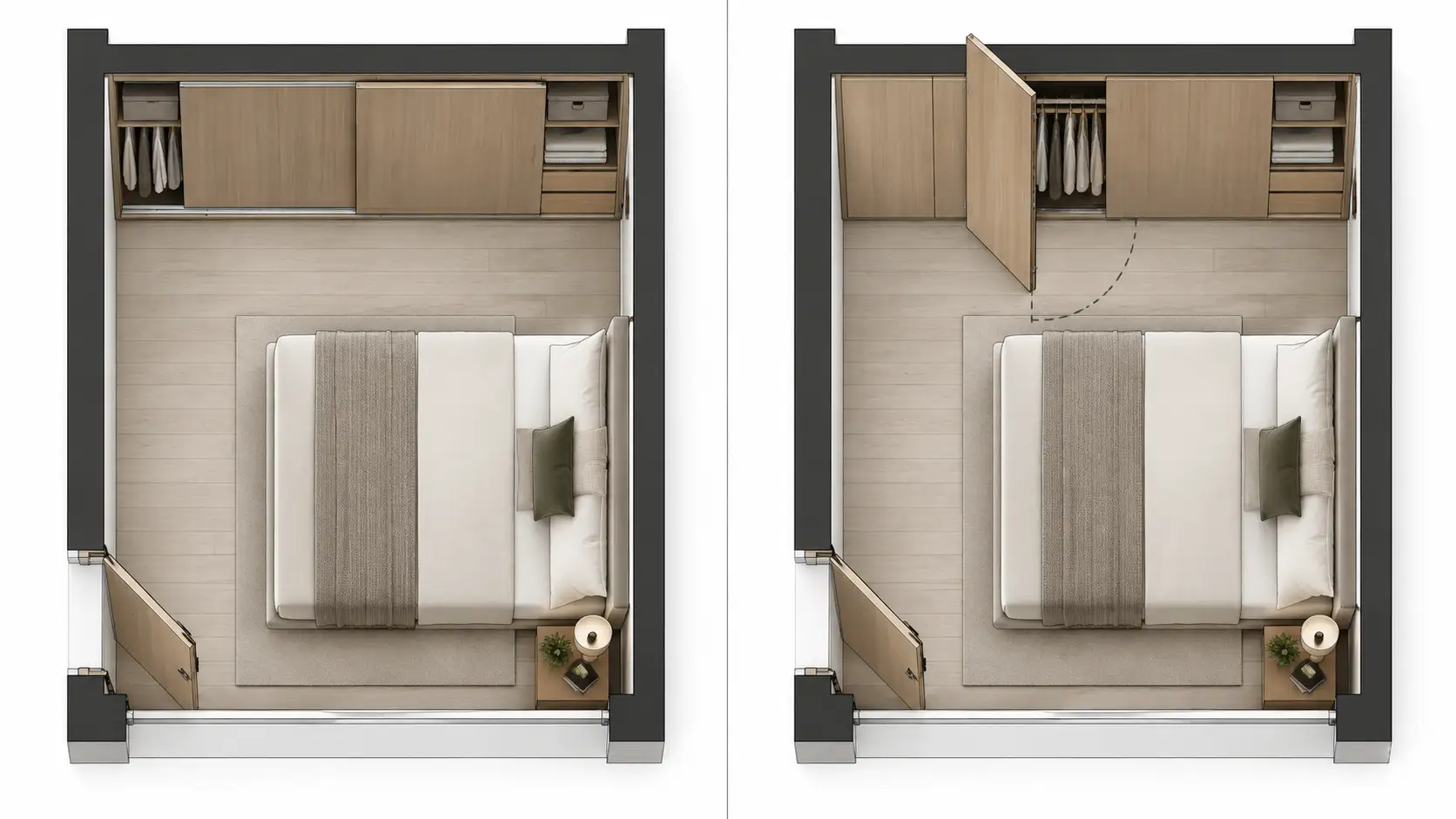
1. Which Uses Less Bedroom Space?
This is the biggest practical difference.
Sliding Doors
Sliding doors do not need a door swing area.
If a bed sits relatively close to the wardrobe, the panel can still move sideways without hitting it.
But this does not mean the wardrobe requires no usable space in front.
A person still needs enough room to:
- Stand in front of the wardrobe
- Reach clothes
- Pull out drawers
- Access lower storage
- Move through the bedroom
The swing arc disappears, but the circulation space does not.
Hinged Doors
A hinged door needs enough space to rotate outward.
The usable clearance depends on the actual width of the door leaf and how far it needs to open.
Do not select a hinged system only from the room’s empty dimensions.
Check the room with:
Wardrobe + Bed + Bedside Table + Door Swing + User Standing Space
This is especially important in compact bedrooms.
If you are deciding whether the room should use a built-in wardrobe or a larger closet solution, see our Built-In Wardrobe vs Walk-In Closet guide.
2. Which Gives Better Access to the Wardrobe Interior?
Hinged doors usually provide more direct access to individual cabinet sections.
Open one door and the storage behind it is immediately available.
If several doors can remain open at the same time, users can also view multiple storage zones together.
Sliding doors work differently.
One panel moves in front of another, so part of the wardrobe remains covered.
However, it is inaccurate to say that every sliding wardrobe only gives access to exactly 50% of the cabinet.
The clear opening depends on:
- Number of door panels
- Number of tracks
- Panel width
- Stacking arrangement
- Position of stops and soft-close hardware
A two-panel system may behave differently from a three-panel or multi-track system.
The important specification is not simply “sliding doors.”
It is:
How wide is the usable opening in each door position?
That should be checked before finalizing the internal wardrobe layout.
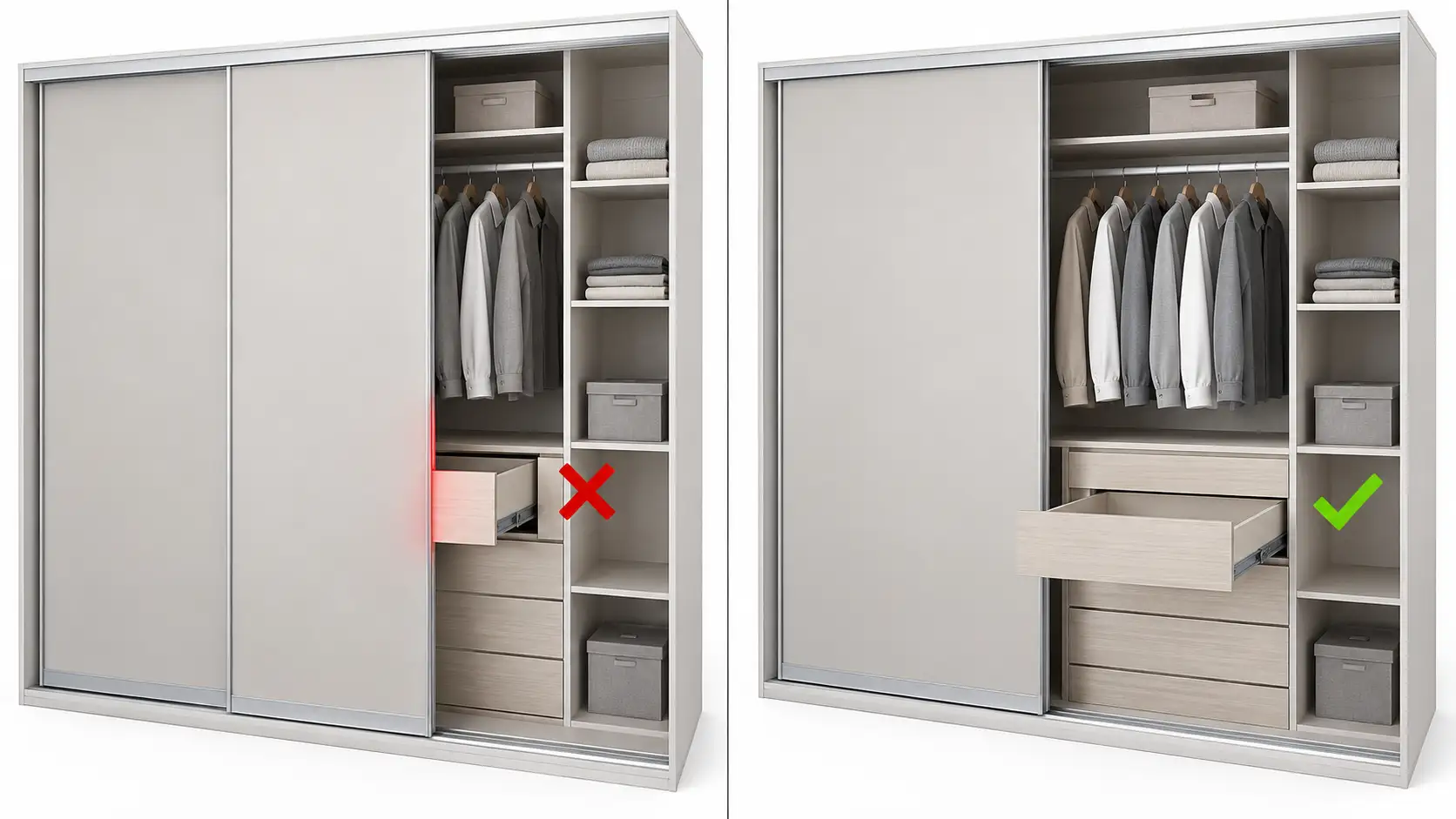
3. Can Sliding Wardrobe Doors Block Internal Drawers?
Yes, if the layout is poorly coordinated.
This is one of the most important details when designing a sliding wardrobe.
Imagine a three-panel wardrobe with a drawer stack positioned behind the joint between two sliding panels.
If the door cannot move far enough to create a clear opening in front of those drawers, the drawer may hit the door edge when pulled out.
The same problem can occur with:
- Pull-out baskets
- Shoe racks
- Jewelry drawers
- Trouser racks
- Internal accessory trays
The solution is not simply to remove drawers.
Instead, the internal modules should be coordinated with the door opening zones.
A good shop drawing should show both:
Door Positions + Interior Storage Modules
before production starts.
4. Are Hinged Doors Always Better for Drawers?
Not automatically.
Hinged doors can give very direct access, but the door still needs to open far enough for the internal drawer to clear the hinge side and door edge.
Problems can occur when:
- The wardrobe is close to a wall
- The door cannot open fully
- A drawer is very close to the side panel
- Handles interfere with an adjacent door
- Wide internal drawers cross several door openings
The correct hinge and door geometry matter.
For wardrobes with many drawers, the manufacturer should check drawer width, door width and hinge opening before approving production drawings.
5. Which Is Better for Small Bedrooms?
Sliding doors often solve one specific problem very well:
They eliminate outward door swing.
That can make them suitable for bedrooms where the wardrobe is positioned opposite or beside the bed.
Current wardrobe design guides consistently identify limited door clearance as the main reason buyers choose sliding systems.
But the smallest bedroom does not automatically require sliding doors.
For example, a narrow built-in wardrobe divided into several small bays may work efficiently with relatively narrow hinged doors.
So rather than asking:
“Is the bedroom small?”
ask:
“What happens when the door opens?”
That is a more useful design question.
6. Which Works Better for Wide Wardrobes?
Sliding systems are often visually effective across long wardrobe walls.
Large panels can create a cleaner front with fewer vertical divisions.
They can also support mirror, glass or decorative finishes depending on the door system.
Hinged wardrobes normally divide a wide cabinet run into more individual door leaves.
That can be useful when each internal storage bay should have its own dedicated door.
Neither arrangement is inherently superior.
For wide wardrobes, check:
- Maximum door size supported by the hardware
- Door weight
- Panel rigidity
- Track or hinge capacity
- Handle arrangement
- Alignment across the full cabinet run
Do not assume that a very large door can simply be produced because the material sheet is available.
The selected hardware system must support it.
7. Sliding vs Hinged Wardrobe Hardware
The hardware is very different.
Sliding Wardrobe Hardware
A typical sliding system may include:
- Upper track
- Lower track or guide
- Rollers
- Anti-jump or stabilizing components
- Stops
- Soft-close devices
- Door profiles
The exact configuration varies by manufacturer.
The panel weight and size must be compatible with the selected system.
Hinged Wardrobe Hardware
A hinged system commonly uses:
- Concealed hinges
- Mounting plates
- Soft-close hinges or dampers
- Push-to-open devices in some designs
- Handles or integrated pulls
The hinge quantity and specification should be selected according to door size, weight and construction.
Avoid choosing hardware from appearance alone.
8. Which Requires More Maintenance?
Both systems require maintenance, but the maintenance points are different.
Sliding doors rely on the running system.
Tracks and guides should remain clean, and rollers should continue to move smoothly.
If the door becomes difficult to slide, the cause may be dirt, adjustment, roller wear or cabinet alignment.
Hinged doors do not have long sliding tracks, but hinges can require adjustment over time if doors move out of alignment.
The useful question is not:
“Which system is maintenance-free?”
Neither is.
Instead ask:
“Can the hardware be adjusted, serviced and replaced when required?”
For project buyers, replacement hardware availability is particularly important.
9. Which Is Easier to Keep Clean?
Sliding systems have tracks or guide areas that can collect dust.
This is more noticeable where a lower running track is exposed.
Hinged doors generally have simpler floor-level access, but the gaps around individual leaves and hinge areas still require normal cleaning.
Mirror and glass doors show fingerprints more easily than many matte surfaces regardless of the opening system.
So cleaning should be evaluated together with the door finish, not just the opening mechanism.
10. Which Door Style Looks More Modern?
Sliding wardrobe doors are often associated with contemporary interiors because they allow large uninterrupted surfaces.
Common options include:
- Wood grain panels
- Lacquered panels
- Matte finishes
- Glass
- Mirror
- Mixed-material doors
Hinged doors are more visually flexible than many buyers assume.
They can use:
- Slab fronts
- Shaker-style doors
- Glass doors
- Framed doors
- Integrated handles
- Traditional handles
So sliding does not automatically mean modern and hinged does not automatically mean traditional.
The finish and door profile play a major role.
11. What About Mirror and Glass Wardrobe Doors?
Both opening systems can use mirror or glass in suitable door constructions.
Sliding doors are frequently used with large mirrored panels because the wide front creates a continuous visual surface.
Hinged mirror doors are also possible.
For either option, panel weight becomes important.
The supplier should confirm:
- Glass or mirror thickness
- Frame construction
- Door dimensions
- Hardware capacity
- Edge protection
- Safety requirements
Avoid specifying a glass wardrobe door independently from the hardware system.
12. Which Is Quieter?
Both can operate quietly when properly designed and installed.
Soft-close sliding hardware can slow a moving panel near the closing position.
Soft-close hinges can perform a similar function on hinged doors.
Noise problems are more likely when:
- Hardware quality is poor
- Tracks are dirty
- Doors are misaligned
- Cabinets are out of square
- Components are incorrectly adjusted
So there is no useful rule that one opening type is always quieter.
13. Which Costs More?
There is no universal answer.
Sliding systems may require specialized tracks, rollers, profiles and large door panels.
Hinged systems may use many individual doors and multiple hinges.
The final cost also depends on:
- Wardrobe dimensions
- Door material
- Finish
- Mirror or glass
- Hardware brand and specification
- Soft-close system
- Internal drawers and accessories
- Installation
A fair comparison should keep the rest of the wardrobe specification the same.
Compare:
Same Cabinet Size + Same Carcass + Same Finish Level + Comparable Hardware + Same Installation Scope
Then compare the two door systems.
A fixed statement such as “sliding is always more expensive” or “hinged is always cheaper” is too simplistic.
14. Sliding vs Hinged Doors for Walk-In Closets
Walk-in closets create a different design condition because the storage is inside a dedicated space.
Many walk-in closets use open wardrobes or glass-front cabinets, but hinged and sliding doors can both be appropriate.
In a narrow walk-in closet, door swing can interfere with the central aisle.
In a larger dressing room, hinged glass doors may provide excellent direct access.
The door system should therefore be planned together with aisle width, islands, drawers and corner storage.
Our Walk-In Closet Design Mistakes guide covers the broader layout issues that should be checked before cabinetry is finalized.
How to Choose Between Sliding and Hinged Wardrobe Doors
Use the room and wardrobe layout to make the decision.
Choose Sliding Doors When:
- The bed or furniture is close to the wardrobe
- Door swing would block circulation
- You prefer large continuous door panels
- A wide wardrobe wall needs a clean appearance
- The internal layout can be coordinated with the sliding opening zones
Choose Hinged Doors When:
- There is comfortable space in front of the wardrobe
- You want direct access to individual storage bays
- The wardrobe contains many drawers or pull-outs
- You prefer multiple smaller doors
- You want inset-style detailing or more traditional door treatments
For some projects, a mixed solution may also be possible.
Different rooms do not need to use the same door system simply because they belong to the same house.
What Should Be Confirmed Before Production?
Before approving a custom wardrobe, confirm:
- Overall wardrobe width and height
- Bedroom furniture positions
- Door opening method
- Number of sliding panels or hinged leaves
- Clear opening width
- Internal drawer positions
- Hanging sections
- Shoe storage
- Pull-out accessories
- Door material and finish
- Mirror or glass requirements
- Hardware system
- Handle or handleless preference
- Wall, floor and ceiling conditions
The wardrobe should then be reflected in shop drawings before production.
This is especially important for custom projects where site dimensions are different from standard modular furniture.
FAQ
Are Sliding Wardrobe Doors Better Than Hinged Doors?
Not universally. Sliding doors are useful where front clearance is limited, while hinged doors usually provide more direct access to storage sections.
Do Sliding Wardrobe Doors Save Space?
They remove the outward door swing, which can help in tight bedrooms. Users still need enough space to stand, walk and use internal drawers.
Can Sliding Wardrobe Doors Have Drawers Inside?
Yes. The drawers must be positioned so the sliding panels can create enough clear opening for them to extend.
Can Hinged Wardrobe Doors Work in Small Bedrooms?
Yes, especially when narrow door leaves can open without hitting the bed or other furniture.
Are Sliding Wardrobe Doors More Expensive?
Not always. Cost depends on panel size, finish, tracks, rollers, soft-close hardware and installation.
Are Sliding Wardrobe Doors Good for Mirrors?
Yes. Large mirrored sliding panels are common, provided the door system is designed for the panel size and weight.
Which Wardrobe Door Is Easier to Repair?
That depends on the hardware system and availability of replacement components. Hinges, rollers and tracks should all be serviceable where possible.
Which Wardrobe Door Is Better for a Walk-In Closet?
Either can work. The better system depends on aisle width, drawer placement, wardrobe depth and the overall dressing-room layout.

Conclusion: Design the Doors and Interior Together
The real difference between sliding and hinged wardrobe doors is not simply appearance.
Sliding doors remove the outward swing and can work well where bedroom space is tight.
Hinged doors require more front clearance but usually provide more direct access to individual storage zones.
The most important design issue is coordination.
Door Movement + Clear Opening + Drawers + Interior Storage + Hardware + Room Layout
should be planned as one system.
A wardrobe should not be designed internally first and given doors afterward.
For custom projects, compare both options using the actual room dimensions and storage requirements before production begins.
Planning a Custom Wardrobe?
OKBuild can develop custom wardrobe layouts based on your room dimensions, storage requirements, preferred door system, finishes and hardware.
Send your room dimensions, bed position, wardrobe wall size, storage requirements and reference images so sliding and hinged options can be compared before shop drawings and production.