Types of Cabinet Hinges: Overlay, Inset & Closing Options

- 2026/11/2
- By Colin Pun, OKBuild Project Manager
Table of Contents
ToggleThe right cabinet hinge depends on how the cabinet is built, where the door sits and how it should move. Common types of cabinet hinges include concealed cup hinges, visible butt hinges, surface-mounted designs and wrap-around hinges. Pivot and knife hinges serve more specialized furniture applications.
Overlay, inset, self-closing and soft-close describe other parts of the specification. A concealed hinge can also be an overlay hinge and have a soft-close mechanism. Treating those terms as competing alternatives makes it easy to order hardware that looks suitable but does not fit.
Start with the cabinet and door arrangement. Then choose a hinge construction, check its mounting requirements and confirm the opening and closing functions. This guide explains the distinctions for kitchen cabinets, wardrobes and other fitted cabinetry, including what to record when replacing existing hinges.
Start with the Cabinet and Door Arrangement
Before comparing cabinet hinge types, identify the structure that will carry the hinge. A decorative door style alone does not tell you where the hardware attaches.
Face-frame cabinets
A face-frame cabinet has a frame attached to the front of the cabinet box. Depending on the system, the hinge can attach to that frame or use another approved mounting arrangement.
Face frame cabinet hinges are available for different door positions. Some are visible when the door is closed. Others are concealed, including compact designs developed for face-frame applications. A face frame does not automatically mean an exposed hinge or an inset door.
Frameless cabinets
A frameless cabinet has no separate front face frame. Concealed hinges commonly attach to the cabinet side through a mounting plate or another system-specific arrangement.
Frameless cabinet hinges must suit the door position and cabinet geometry. An overlay door covering an outside cabinet side is a different application from two doors meeting over a shared partition. An inset door requires a different relationship again.
If the cabinet construction is still undecided, compare the wider layout and access implications in the framed vs frameless cabinets guide. For hinge selection, the immediate task is to identify the mounting surface, door position and space around the opening.
Cabinet Hinge Types at a Glance
Use the following table to identify what a product name actually describes. Several descriptions can apply to the same hinge.
| Description | What it tells you | What still needs checking |
|---|---|---|
| Concealed cup hinge | A hinge construction hidden from normal view when the door is closed | Door preparation, arm, mounting plate, cabinet type and intended application |
| Butt hinge | Two leaves connected around a hinge pin or knuckle | Leaf shape, mounting detail, door position and visible portion |
| Surface-mounted hinge | A mounting arrangement fixed to designated surfaces | Exact fixing positions, visibility, clearances and whether other preparation is required |
| Wrap-around hinge | A hinge with a mounting leaf or bracket shaped around a cabinet-frame edge | Frame profile, wrap geometry, door application and fixing access |
| Pivot or knife hinge | A furniture hinge arrangement with a particular pivot location or compact leaf form | Cabinet construction, machining, support and clearance requirements |
| Overlay or inset hinge | The door-to-cabinet relationship the hinge is intended to achieve | Required overlay or inset geometry and the complete compatible hardware combination |
| Self-closing or soft-close hinge | A closing function or damping feature | Whether closing force, damping and any latch work together in the selected system |
Surface mounting is not a guarantee that a hinge will fit existing holes. Likewise, a product described as concealed is not necessarily interchangeable with another concealed hinge.
Concealed, Exposed and Other Hinge Constructions
Concealed cup hinges
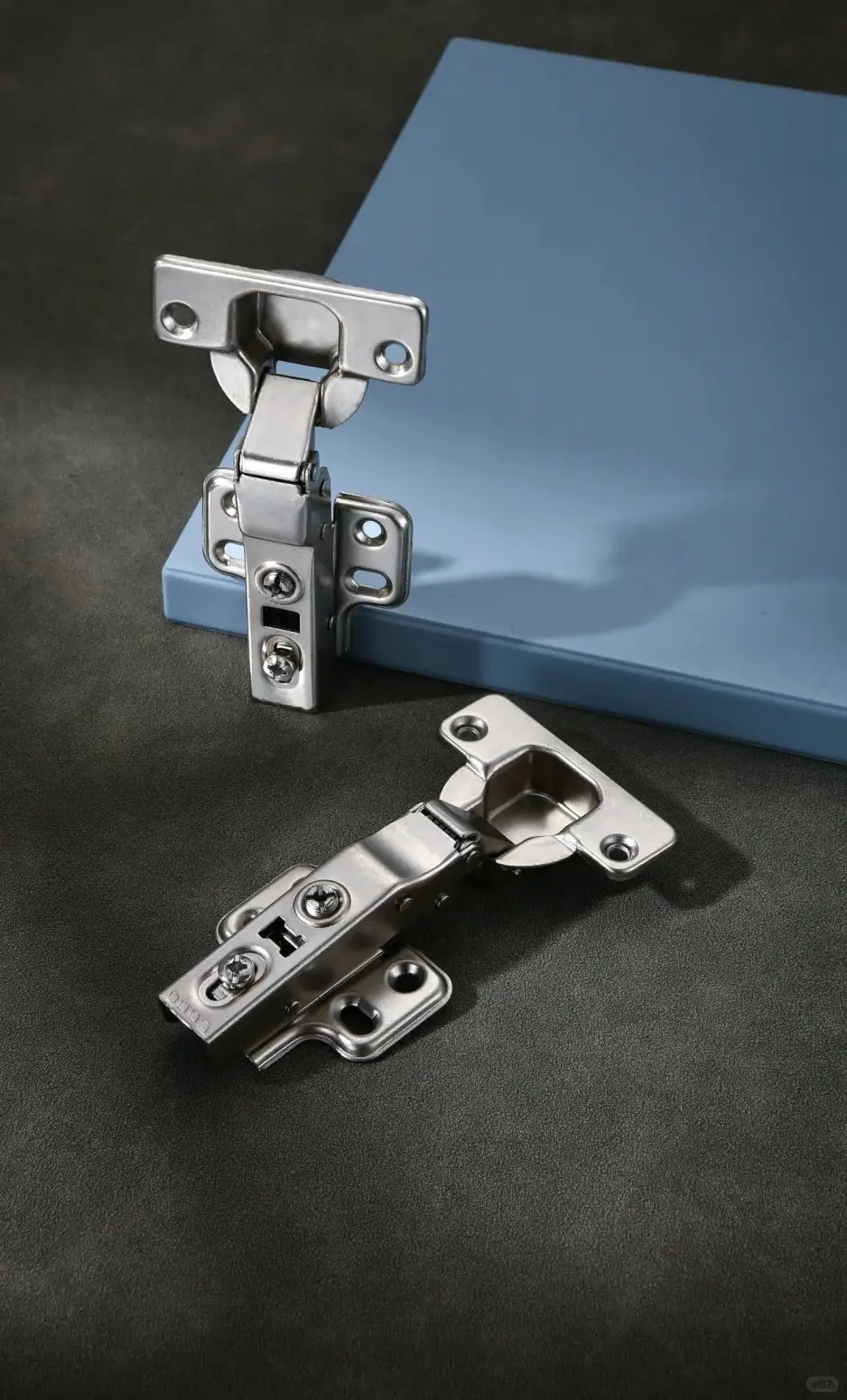
Concealed cabinet hinges are widely used in fitted kitchens and wardrobes. A common construction has a cup fitted into the back of the door, an articulated arm and a cabinet-side attachment. Many systems use a separate mounting plate.
The cup, arm and plate form a working combination. The door position depends on that combination and the specified drilling and cabinet geometry. Matching the cup diameter alone does not establish compatibility.
Check the cup depth, fixing pattern, distance from the door edge, door thickness range and mounting-plate requirements. Some doors and hinge families use different preparations. Thin fronts, glass doors and metal-framed doors can require dedicated hardware rather than a standard cup arrangement.
Concealed hinges are often called European-style hinges. That label is useful for identifying a broad product family, but it does not prove that a hinge is only for frameless cabinetry or that parts from different suppliers will fit together.
Butt, exposed and semi-concealed hinges
A butt hinge has two leaves joined at a pivot. Cabinet versions can use different leaf shapes and mounting preparations. The knuckle may remain visible along the door edge, depending on the application.
Exposed hinges can make the hardware part of the cabinet’s appearance. Semi-concealed designs hide some components while leaving another portion visible. Finish, knuckle shape and fixing positions therefore matter as well as function.
For replacement work, photograph the hinge with the door open and closed. Record how each leaf sits against the cabinet and door. A similar decorative finish is not enough to establish that the new hinge will maintain the existing gaps and swing.
Surface-mounted and wrap-around designs
Surface-mounted cabinet hinges attach to designated door and cabinet surfaces. Their layouts vary. Some emphasize visible decorative leaves, while others use less conspicuous arrangements. Check the actual product drawing instead of assuming that the name describes one universal construction.
Wrap-around designs use a shaped cabinet-side section that extends around part of a frame edge. Partial-wrap and full-wrap descriptions refer to that mounting geometry. They are different from partial-overlay and full-overlay door positions.
The frame profile, hinge offset and door relationship must suit the selected design. A wrap-around hinge intended for one frame construction is not a general replacement for every face-frame hinge.
Pivot, knife and special-purpose hinges
Pivot and knife hinges can suit particular furniture designs where the pivot position or a compact hinge form is important. Some arrangements use top and bottom mounting positions rather than the familiar cup-and-plate layout along a cabinet side.
These are design-specific choices. Confirm the mounting surfaces, machining, door construction and product application before selecting them. They should not be treated as an automatic way to reuse existing concealed-hinge holes.
Overlay and Inset Door Applications
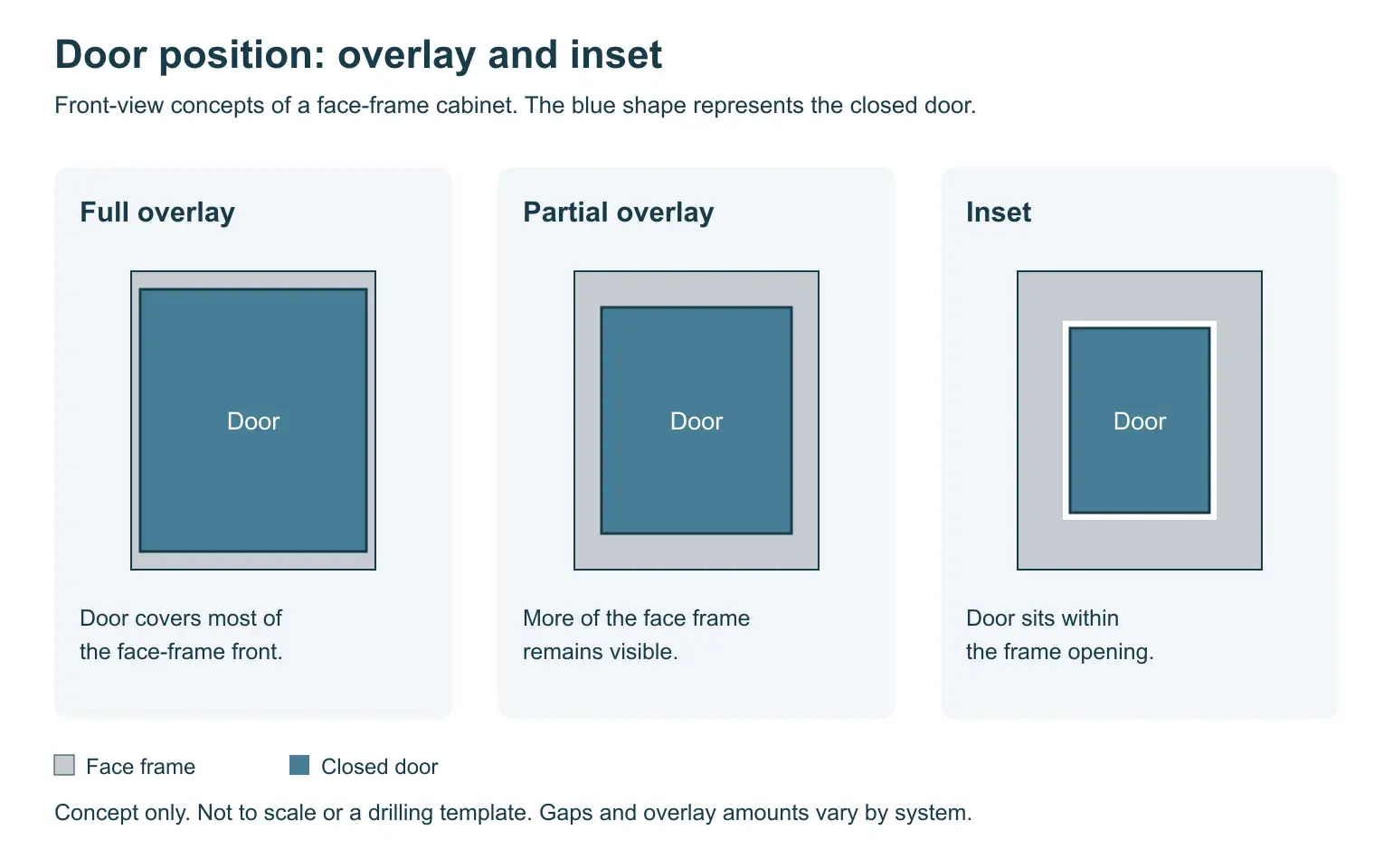
Door position describes where the closed door sits relative to the supporting frame or cabinet side. It does not describe whether the hinge is concealed or how gently it closes.
Overlay cabinet hinges
An overlay door covers part of the front edge or face of the cabinet structure. Overlay cabinet hinges must produce the required coverage while allowing the door to open without interference.
Full-overlay and partial-overlay terms describe different amounts of coverage in the relevant system. Full overlay does not mean there is no operating clearance. The designer still needs to coordinate gaps between doors, adjacent cabinets, end panels and other obstructions.
In frameless hinge systems, half-overlay commonly describes an application where two doors share a cabinet division. It is not a reliable substitute for every supplier’s partial-overlay description. Confirm the actual door position and required overlay rather than ordering from the name alone.
Inset cabinet hinges
An inset door sits within the frame or cabinet opening. Inset cabinet hinges must locate the door correctly within that opening and provide the necessary movement past its edges.
The visible gaps, door thickness, edge shape and hinge geometry need to work together. A hinge designed for an overlay application should not be assumed to become an inset hinge through adjustment alone.
For a new cabinet, show the intended door position on the drawing. For an existing cabinet, record the closed-door relationship before removing the hardware. This is more useful than describing the door simply as modern, traditional or handleless.
Soft-Close, Self-Closing and Free-Swinging Actions
Closing force and closing speed are separate functions. A hinge may combine them, but the terms are not interchangeable.
Self-closing cabinet hinges
Self closing cabinet hinges use a closing mechanism to pull the door toward the closed position through a defined part of its travel. That does not mean the door will close itself from every possible opening angle.
Self-closing also does not guarantee a cushioned final movement. A system can pull a door shut without damping its closing speed. Check the specified closing behavior and how the door is intended to stay closed.
Soft-close cabinet hinges
Soft close cabinet hinges include or work with damping that slows the final closing movement. Depending on the product, the damper can be integrated into the hinge or supplied as a compatible separate component.
Check how the damping is configured for the actual door. Some systems offer adjustment or selective damper activation. The appropriate arrangement depends on the manufacturer’s guidance, door characteristics and hinge combination.
A separate soft-close device is not a universal upgrade for any existing hinge. It needs suitable mounting space and a compatible closing system. Confirm those conditions before specifying a retrofit.
Free-swinging and push-to-open arrangements
A free-swinging hinge does not provide the same self-closing action as a sprung version. The door may rely on another compatible device to stay closed or operate as intended.
Push-to-open is a complete operating arrangement involving the hinge, release mechanism and door movement. Some systems require an unsprung hinge, while other product arrangements have different compatibility rules. Do not combine a push device, self-closing hinge and damper merely because each is sold for cabinet doors.
Test the selected combination on a representative door. A handleless appearance does not establish that the operating hardware is correct.
Opening Clearance, Corners and Special Applications
An advertised opening angle is useful, but it does not describe all the space the door and hinge occupy as they move.
Check the swing beside a wall, filler panel or neighboring handle. Consider the thickness and shape of the door edge, anything projecting from the front and the access required inside the cabinet.
Internal drawers and pull-out storage need enough clearance to pass the open door and hinge. Certain hinges are designed to move the door clear of the opening in specified applications. A wide-angle label alone does not establish that the required drawer or basket will clear.
Corner cabinets add further conditions. A door on an angled cabinet front and two connected doors folding together are different applications. They may require different hinge families and opening arrangements. Confirm the actual plan and section rather than requesting a generic corner hinge.
Tall, wide or heavy doors also need product-specific selection. Hinge quantity and spacing depend on the manufacturer’s application guidance and the door’s dimensions, weight and construction. There is no dependable rule that every cabinet door needs the same number of hinges.
For a wardrobe, decide whether the door arrangement itself suits the room before refining the hardware. The sliding vs hinged wardrobe doors guide explains the wider access and circulation considerations.
What to Check Before Specifying or Replacing a Hinge
For a new cabinet, select the hinge system before finalizing the door and cabinet machining. For replacement work, identify the existing arrangement before purchasing hardware.
Record the following:
- Cabinet construction: face frame or frameless, mounting surface and any shared divisions.
- Door position: overlay or inset, required coverage and intended visible gaps.
- Door details: dimensions, weight, thickness, material and edge profile.
- Existing preparation: cup or recess dimensions, fixing pattern, edge setback and cabinet-side holes where applicable.
- Hardware identification: manufacturer marks, hinge code, arm configuration and mounting-plate identification.
- Opening requirements: adjacent walls and handles, internal drawers, pull-outs and corner arrangements.
- Closing requirements: self-closing, damping, latch or push-to-open functions and their approved combination.
- Application conditions: intended use, exposure, mounting substrate and the relevant product limitations.
For an existing door, keep photographs, measurements and the old hinge and plate available for comparison. A hinge code can identify a family without fully describing every mounting option. Include the plate and door application when asking for a replacement.
Check the condition of the mounting area as well. New hardware cannot be assumed to resolve damaged fixing positions, an unsuitable substrate or a distorted cabinet. Have the responsible cabinet professional assess those conditions before deciding how to proceed.
Use a representative sample to check alignment, swing, internal access and closing behavior before approving repeated cabinets. Adjustment should refine a compatible assembly within its intended range. It is not a substitute for the correct hinge geometry or door preparation.

Frequently Asked Questions
What are the main types of cabinet hinges?
Common constructions include concealed cup hinges, butt hinges, surface-mounted and wrap-around designs, plus specialized pivot and knife hinges. Overlay, inset, self-closing and soft-close describe additional application or operating features, so several labels can apply to one hinge.
Are concealed hinges only for frameless cabinets?
No. Concealed hinge systems exist for both frameless and face-frame cabinets. Choose the hinge and mounting arrangement for the actual cabinet construction and door position.
What is the difference between overlay and inset hinges?
An overlay application places the door over the supporting cabinet edge or frame. An inset application places it within the opening. The hinge geometry, mounting arrangement and door preparation must suit that relationship.
Are soft-close hinges the same as self-closing hinges?
No. Self-closing describes the mechanism that draws the door toward closed. Soft-close describes damping that slows the final movement. A product can combine both functions, but neither label should be used as a substitute for checking the complete specification.
Can I replace cabinet hinges without changing the holes?
Sometimes a compatible replacement is available, but it must match more than the visible hinge shape. Check the door preparation, fixing pattern, arm, mounting plate, door position and clearance requirements. Confirm the exact replacement before drilling or ordering a full set.
How many hinges does a cabinet door need?
Use the selected manufacturer’s guidance for the actual door dimensions, weight, construction and application. Confirm the recommended quantity and arrangement rather than applying one number to every door.

Plan the Cabinet and Hardware Together
The most useful hinge specification identifies the cabinet, door position, compatible mounting parts and required movement together. That gives a cabinet maker or supplier enough context to check the complete arrangement.
When discussing cabinetry with OKBuild, include the layout, door elevations and the access or closing functions you want. A clear brief helps the team coordinate suitable options with the wider cabinet design.