Window Condensation: Inside, Outside or Between Panes?

- 2026/10/23
- By Colin Pun, OKBuild Project Manager
Table of Contents
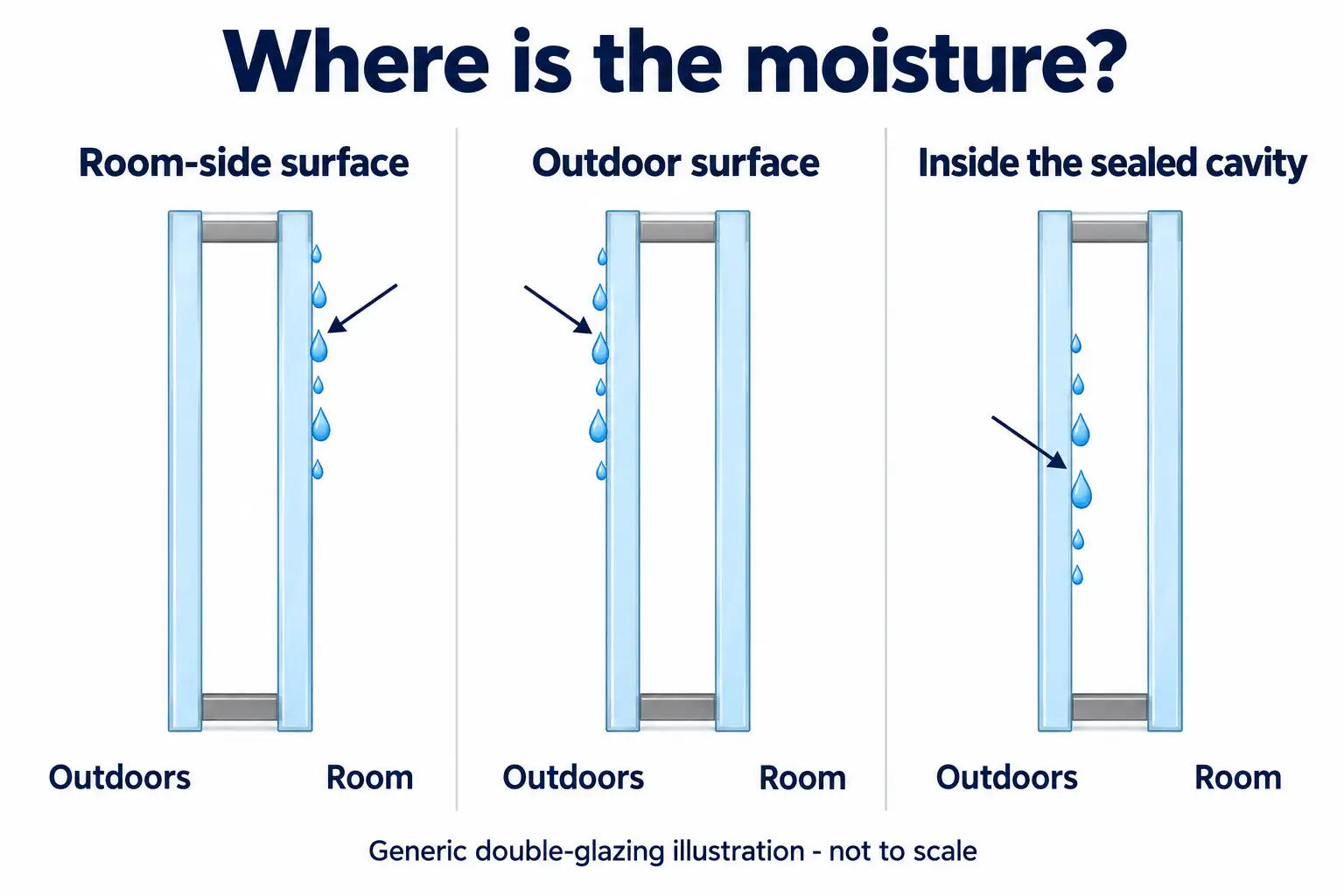
ToggleWater on a window can mean different things depending on where it appears. Droplets on the room-facing glass, dew on the outdoor surface and mist inside a sealed glass unit can look similar from across a room, but they call for different checks.
Before changing the ventilation or ordering replacement glass, locate the moisture. That first observation makes the next decision more useful and avoids treating every cloudy window as the same problem.
This guide explains the three main locations of window condensation, practical steps for investigating recurring moisture and what to discuss with a supplier when the cause remains uncertain.
First Locate the Moisture
Start with the surfaces you can safely reach. On accessible glass, cleaning and drying a small area can help establish whether the visible water is on that face. Do not lean out of a window or dismantle the glazing to reach an outdoor surface.
| Where the moisture appears | What it may indicate | Useful next step |
|---|---|---|
| Room-facing glass | Room air meeting a sufficiently cold surface | Check moisture sources, room conditions and air circulation near the glass |
| Outdoor glass | Outdoor air meeting a sufficiently cold exterior surface | Record the weather and whether it clears as conditions change |
| Apparently inside a sealed glass unit | Possible moisture within the sealed cavity | Ask a qualified supplier or glazing professional to confirm the location and condition |
| Around the frame, wall or sill | Condensation, water entry or another moisture source | Record the pattern, weather and surrounding damage before assuming a cause |
If a mark remains after accessible surfaces are cleaned, it may be within the assembly, but marks and deposits can also be mistaken for mist. Treat the observation as a reason for closer assessment rather than a diagnosis by itself.
Also identify the glazing arrangement. A factory-sealed insulating glass unit is different from a primary window with an additional storm window or a separate secondary glazing panel. Moisture in those different cavities does not necessarily mean the same component has failed.
Why Condensation Forms on a Glass Surface
Moisture and Surface Temperature Work Together
Condensation can form when a surface is cold enough relative to the moisture in the air touching it. The dew point describes the temperature at which that air would reach saturation; if the glass surface becomes sufficiently cold, water can collect on it.
The temperature of the glass is therefore important, not only the temperature displayed by the room thermostat. A room can feel comfortable while the glass or its edges are cooler.
Likewise, a temperature difference between indoors and outdoors does not explain every case on its own. The amount of water vapor, the local surface temperature and the conditions around that surface all matter.
Relative Humidity Is Useful Context
A suitable room humidity meter can help you record conditions over time. Follow its instructions and record room temperature as well as relative humidity, noting where the reading was taken.
One reading is not a complete diagnosis. Humidity changes with activities and weather, and a room measurement does not directly measure the temperature of the glass. A target appropriate for one building and season may not prevent condensation in another.
For a recurring problem, compare observations at the same window before and after normal activities such as cooking, showering or drying clothes. The pattern is often more informative than an isolated number.
Airflow Changes Conditions Near the Glass
Deep reveals, tightly closed blinds and heavy curtains can reduce room-air circulation at the window. This can leave the glass area in different conditions from the middle of the room.
Review the window with its usual coverings in place. Where appropriate, opening blinds or allowing more air circulation can help, but the result still depends on the room’s moisture level, temperature and window construction.
Condensation on the Inside of Windows
Interior window condensation is often most noticeable during colder weather, when the room-facing surface becomes cooler. It may appear first near edges or behind coverings, but the pattern alone does not identify a defective part.
Start with practical changes that address the room and protect the surrounding finishes.
Reduce Avoidable Moisture Sources
Use the building’s kitchen and bathroom extraction systems as intended, and check that they are operating properly. Consider the effect of indoor clothes drying, frequent showers, cooking and any humidifier.
If a humidifier is running, review its setting against the current weather and the equipment or building guidance. Do not assume that a fixed setting will suit every season or window.
The objective is to manage the moisture load, not simply to wipe the same water away every morning. Where the building has a designed ventilation system, keep its operation and maintenance part of the review.
Choose Ventilation or Dehumidification for the Climate
Ventilation can remove moisture when the outdoor conditions and the ventilation arrangement make that effective. It is not a universal instruction to leave windows open.
In a hot, humid climate, bringing in outdoor air can increase the indoor moisture load, particularly in an air-conditioned building. Dehumidification and cooling may need to be coordinated with the required ventilation rather than treated as interchangeable solutions.
Use the building’s intended system and seek appropriate assessment if humidity remains difficult to control. A dehumidifier may help manage room moisture, but it cannot repair a sealed glass unit with an internal problem.
Review Heating and Window Coverings
Appropriate room heating and circulation can affect the room-side glass temperature. Raising the air temperature alone, however, does not remove water vapor from the building.
Check whether furniture or coverings obstruct the intended airflow near the window. Test a change in the usual blind or curtain position where practical, and record whether the pattern changes under comparable weather conditions.
Dry Water and Inspect the Surroundings
Remove accessible water and dry the sill or nearby finishes using methods suitable for their materials. This protects the area while the cause is investigated.
Recurring standing water, damaged finishes, musty odors or visible mold deserve further assessment. Address the moisture source rather than covering the damage or assuming that a different window alone will resolve it.

Condensation on the Outside of Windows
Outdoor condensation can occur when the exterior glass surface is cooler than the dew point of the surrounding outdoor air. It may appear overnight or early in the morning and clear as the surface warms or conditions change.
Efficient glazing can experience exterior dew because less heat from inside reaches the outdoor pane. Clear-sky cooling and local exposure can also affect the surface temperature. In a warm, humid climate, a cool air-conditioned interior can contribute to exterior-surface conditions as well.
Exterior dew alone proves neither a defective window nor a particular level of energy performance. A photograph of wet glass cannot verify the window’s specification.
Record when it occurs, whether it is on the safely observable outdoor face and how it changes during the day. Different orientations, shelter and surrounding conditions can produce different patterns even in the same building.
If moisture appears trapped within the glass, if the view stays cloudy after the outdoor surface clears, or if water is entering the building, arrange a closer check. Those observations require a different explanation from temporary dew on an exposed surface.
Condensation Between Window Panes
First Confirm That It Is a Sealed Unit
In a factory-sealed insulating glass unit, persistent moisture on a cavity-facing surface can indicate a problem with the unit’s sealed condition. Have the location and cause confirmed by a qualified glazing professional or the original supplier.
Cleaning an accessible glass face does not reach that cavity. Adjusting indoor humidity may help separate room-side condensation from the observation, but it is not a repair to an internal sealed-unit problem.
An additional storm window or a window with a separate accessible glazing panel needs its own assessment. Its cavity and moisture-management instructions can differ from those of a factory-sealed unit. Do not assume that every space between two visible panes is the same kind of sealed cavity.
Assess the Glass, Sash and Frame Before Choosing a Remedy
A problem within an insulating glass unit does not automatically mean the entire window frame must be replaced. Depending on the product and its condition, an appropriate remedy may involve the glass unit, a sash or a larger assembly.
Ask the supplier to identify the actual window and review its service arrangements, any applicable warranty and the condition of the frame and installation. Availability and repair options depend on that specific system.
Keep photographs and observations before arranging work. An assessment based on the actual assembly is more useful than selecting a replacement from the word “foggy” alone.
Check Whether the Water Is Condensation or Water Entry
Water at a frame or sill can have more than one source. Note whether it appears after rain, during particular wind conditions, after indoor moisture-producing activities or mainly during cold nights.
Look for the extent of the wet area and any marks on the surrounding wall. These observations can help a professional decide what to investigate, but they do not by themselves distinguish a leak from condensation.
Keep designed drainage paths clear in accordance with the window’s maintenance instructions. Do not block weep holes or seal an opening simply because water is visible near it. If you are unsure whether an opening is a drain, vent or defect, ask the supplier before altering it.
Persistent water entry, loose or damaged components, or deterioration around the opening should be assessed rather than treated only by changing the room humidity.
Will Different Glazing or Frames Prevent Condensation?
Compare the Complete Window
Glazing and frame design affect heat flow and surface temperatures, but so do the installation and the building’s conditions. A glass upgrade is not a promise of dry surfaces in every room and climate.
For an overview of glazing options, use the double versus triple glazing guide. The number of panes alone does not establish every aspect of the window’s performance or explain where today’s moisture is located.
Distinguish Thermal Breaks from Glazing Features
A thermal break reduces heat transfer through the relevant frame construction. It is different from adding another pane or changing a glass coating. The thermal-break aluminum windows guide explains that frame feature in more detail.
Low-emissivity coatings are another part of the glazing specification; the low-E glass guide covers their role. Ask for the actual glass make-up and complete window data rather than assuming that the labels “thermal break,” “double glazed” and “low-E” are equivalent guarantees.
Use Performance Data in Its Proper Context
Where a condensation-resistance rating is supplied, check its test method and scope. For example, an NFRC CR rating compares the potential for interior-surface condensation under standardized conditions; it is not a guarantee of dry surfaces in use.
For a new project, coordinate the window specification with climate, room use, ventilation, cooling or heating and the installation detail. For an existing problem, identify the moisture location before deciding which part of that system needs attention.
What to Record Before Contacting a Supplier
Provide a short factual record:
- The window location, opening type and product identification if available.
- Whether water is on the room face, outdoor face, apparently within the glass, or around the frame.
- When it appears, how long it remains and whether it follows rain or indoor activities.
- Room temperature and humidity readings, including the time and measurement location.
- The weather, orientation and usual position of blinds or curtains.
- Photographs of the whole window, the moisture and any affected surrounding finishes.
- Changes already tried and what happened under comparable conditions.
Describe what you observed without assuming a failed component. This gives the supplier, installer or building professional a clearer starting point and helps avoid repeating the same checks.

Window Condensation FAQ
How Can I Stop Condensation on Windows?
First locate the moisture. Room-side condensation calls for a review of moisture sources, surface temperatures and airflow. Temporary exterior dew may clear with changing conditions. Suspected moisture within a sealed unit needs product assessment rather than a room-humidity adjustment alone.
Is Window Condensation in Winter Always a Fault?
No. Cold conditions can make room-side surfaces cool enough for condensation, depending on the indoor moisture level and window construction. Recurring water still deserves attention, particularly where it affects finishes or the view appears cloudy within the glass.
Is Condensation Outside a Sign of Good Windows?
It can occur on efficient glazing, but it does not verify a particular product’s performance. Weather, surface temperature and exposure also matter. Distinguish accessible exterior dew from moisture apparently trapped inside the glass unit.
Does Mist Between Panes Mean I Need a Whole New Window?
Not automatically. First confirm the glazing arrangement and the location of the moisture. The appropriate service option depends on the glass unit, sash, frame, installation condition and product support; it is not determined by a distant photograph alone.
Should I Open the Windows to Prevent Condensation?
Only where the climate, weather and building arrangement make that appropriate. Outdoor air can help remove moisture in some conditions and add moisture in others. Coordinate ventilation with any heating, cooling and dehumidification system rather than applying one rule everywhere.

Start with the Location, Then Plan the Response
The practical first step is to identify which surface is wet and record the conditions around it. That separates room-moisture management, temporary outdoor dew and a possible sealed-glass issue before a remedy is chosen.
When discussing windows with OKBuild, include the climate, room use, desired glazing and frame specification, and the installation context. For an existing moisture concern, photographs and a clear location record help make the next assessment more specific.