Door Handing Guide: Left, Right, Inswing & Outswing

- 2026/10/26
- By Colin Pun, OKBuild Project Manager
Table of Contents
ToggleDoor handing describes a door’s orientation, but “left hand” is only useful when everyone uses the same reference side and naming convention. Two people standing on opposite sides of an opening can describe the same door differently. A door supplier and a hardware supplier may also use different labels for the same physical arrangement.
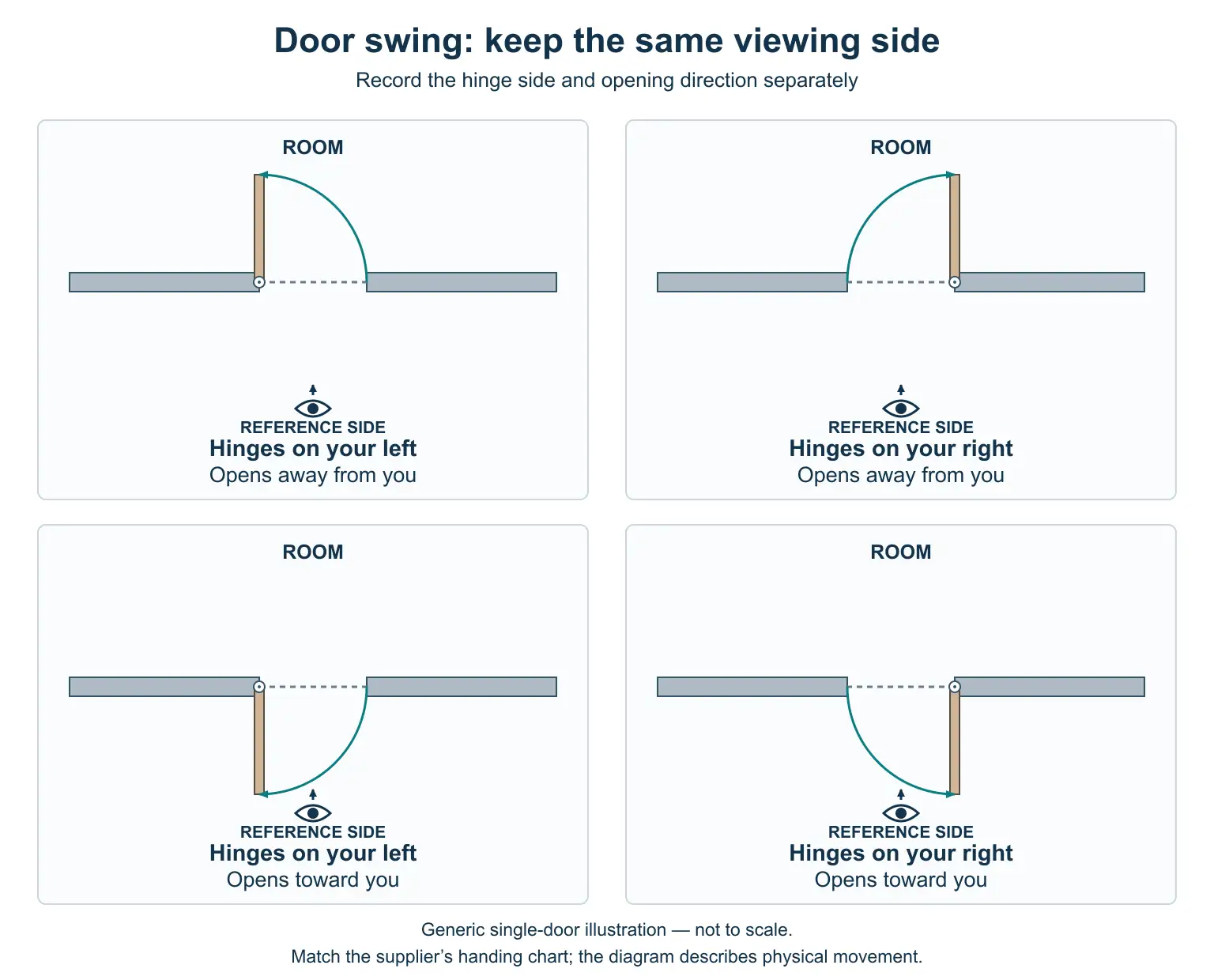
To identify a single hinged door clearly, record three things: the side you are viewing from, the hinge side from that position, and whether the leaf opens toward you or away from you. Then match that arrangement to the supplier’s handing chart before ordering.
This guide explains how to determine door swing, read a door handing diagram and communicate the result for a new door, replacement leaf or hardware package.
Start with the Viewing Side
Identify the Two Spaces
For a front entrance, “outside” and “inside” may seem obvious. For a bedroom door, corridor entrance or commercial opening, those words can be less clear. Name the spaces instead: corridor to office, hallway to bedroom, or exterior terrace to living room.
Use the reference side required by the supplier’s instructions. In hardware charts, that may be a designated outside face. An interior door does not need to face outdoors to have a designated reference side.
Write the chosen side on your sketch. “Viewed from the corridor toward Office 02” gives a more reliable starting point than “viewed from the front.” Keep that position fixed while describing the rest of the opening.
Locate the Hinges, Then Check the Movement
From the recorded side, establish whether the hinge edge is on your left or right. If hinges are concealed, identify which vertical edge is hinged rather than guessing from a handle photograph. On an existing door, a photograph showing the leaf open can help reveal the arrangement.
Next, record whether the door moves away from you into the other space or toward you onto the reference side. Hinge side and opening direction are separate observations; neither one alone describes the complete arrangement.
Observe an existing door’s normal movement for this check.
Door Handing Chart: Describe the Arrangement First
The following chart keeps one observer on the same reference side. It works as a description of a conventional single hinged door even before an ordering abbreviation has been assigned.
| Hinge edge from the reference side | Movement from that side | Clear description to send with a sketch |
|---|---|---|
| On your left | Opens away from you | Hinges left; leaf opens into the named room |
| On your right | Opens away from you | Hinges right; leaf opens into the named room |
| On your left | Opens toward you | Hinges left; leaf opens onto the reference side |
| On your right | Opens toward you | Hinges right; leaf opens onto the reference side |
How to Read a Door Handing Diagram
In a typical plan view, the wall and jambs locate the opening, a line represents the door leaf, and an arc shows the direction of travel. Identify the hinge point and the space the leaf swings into. Do not assume the top of the page always means inside, or that every drawing is viewed from the same side.
A useful drawing labels both spaces and the reference side. If it also includes a closed-leaf position and a swing arrow, a supplier can understand the movement without relying on the words “left” or “right” alone.
A Simple Door-Schedule Example
Consider an office entrance viewed from its corridor. The hinge edge is on your left, and the leaf opens away from you into the office. Record those physical facts first, together with the opening’s door number. The supplier can then confirm the correct code for that specific door and hardware system.
If the leaf instead opens into the corridor, the description changes even though the hinge edge remains on your left from your original position. That is why a door schedule needs both orientation and movement.
Left Hand vs Right Hand Door: Why Labels Can Differ
One Four-Code Hardware Convention
A common four-code hardware convention uses LH, RH, LHR and RHR. In Allegion’s published lock-handing example used for this table, the observer stands on the designated outside face, notes the hinges, and checks whether the leaf moves away or toward that observer.
| Physical arrangement from that designated side | Example hardware code |
|---|---|
| Hinges left; opens away | LH — left hand |
| Hinges right; opens away | RH — right hand |
| Hinges left; opens toward | LHR — left hand reverse |
| Hinges right; opens toward | RHR — right hand reverse |
This table is an example of that hardware convention, not a universal door-ordering rule. Confirm the chart for the actual product. A residential door-unit supplier may describe an outswing arrangement using a different left/right naming method.
For example, Sun Mountain’s single-door chart describes an outside-view arrangement with hinges on the left and the leaf opening toward the observer as a right hand outswing door. In the Allegion example above, that physical arrangement is left hand reverse. The movement has not changed; the naming system has. Compare the diagrams when translating a door-unit order into a hardware request.
What “Reverse” Adds
In the example above, reverse identifies movement toward the observer on the designated side. It does not mean that you should turn a door unit around, reverse a latch or reuse an inswing unit as an outswing unit.
Changing the intended swing can affect the frame arrangement, hardware preparation and other components. For an exterior opening, the threshold and weather-management details may also matter. Treat a proposed change as a coordinated product decision rather than a change to one letter in an order.
If two documents assign different codes, compare their viewing-side definitions and physical diagrams before deciding that either item is wrong.
Inswing and Outswing Need a Named Reference
Exterior Doors
Viewed from outside a building, an inswing entrance opens into the building; an outswing entrance opens outward toward the exterior side. That describes the movement. The supplier’s handing instructions determine which left/right label accompanies it.
A request for a left hand inswing door or right hand inswing door should therefore include a sketch with the exterior side marked. The same applies to a left hand outswing door or right hand outswing door: confirm the supplier’s definition rather than assuming that an abbreviation from a hardware chart transfers unchanged.
Interior Doors
For an interior opening, name the room and the approach space. “Opens into the bedroom” communicates more than “inswing” when the other person does not know which space you consider inside.
The permitted or appropriate swing direction for a new layout is a separate design decision. Identifying an existing arrangement does not establish whether it suits the project’s access, circulation or other applicable requirements. Have that layout agreed before the door and hardware are ordered.
Door Handing Is Different from Lever Handing
A Handle’s Shape Is Not a Door-Swing Chart
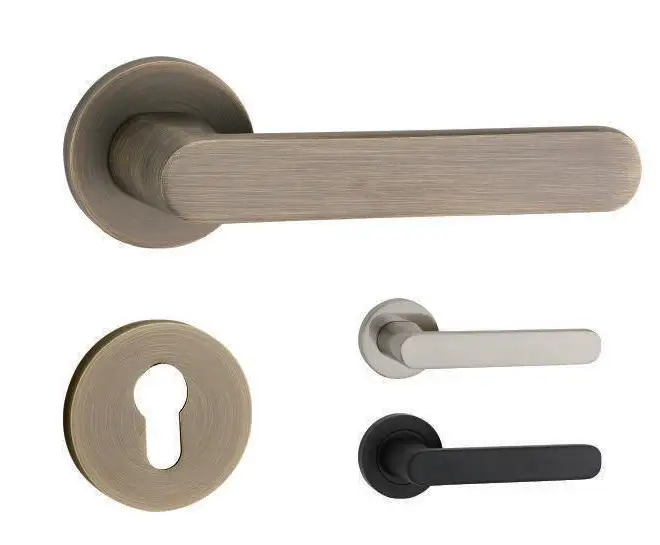
An asymmetric lever may be handed so its shape sits in the intended orientation on the door. Other lever designs or products may be reversible or non-handed. Those properties belong to the selected hardware, not to every handle with a similar appearance.
Do not determine the door’s handing from the direction in which a curved lever points. Likewise, a hardware description such as “left hand lever” should be checked against that manufacturer’s instructions and the side on which the lever will be installed.
One opening may need different lever components on its two faces. Specifying only “two left handles” without identifying their locations can leave the supplier with an incomplete hardware request.
Check the Complete Hardware Set
The relevant question is not simply whether the visible handle can be flipped. Ask whether the complete selected set can serve the required opening, including its lock function, inside/outside orientation and any handed components.
Some products require handing to be specified when ordered; others allow certain changes in accordance with their instructions. Do not assume that field reversibility applies to every function or every component in a range.
Send the hardware supplier the same approved door drawing used for the leaf and frame. Have them confirm the product and ordering code rather than trying to translate several brands’ abbreviations yourself.
Replacement Leaf, New Door Unit or Revised Opening?
Replacing a Leaf in an Existing Frame
For a replacement leaf, record the existing frame’s hinge and latch arrangements as well as the required movement. Matching the stated width and height alone does not establish compatibility with the frame and hardware preparation.
Keep the dimensional survey separate from the handing identification. The standard door sizes guide explains the size information to coordinate; the orientation drawing tells the supplier how that particular opening is intended to operate.
Ordering a New Leaf and Frame Together
A new unit gives the supplier a clearer opportunity to coordinate the frame, leaf and hardware, but the order still needs an agreed direction. Mark the approach space, room and swing on the approved layout rather than leaving the factory to infer them from a room name.
If the design changes after quotation, issue a revised drawing and ask which items are affected before production. A change in swing may require more than substituting a handle.
Changing an Existing Swing
Do not treat an existing door as automatically suitable for the opposite movement. Ask the project team and supplier to assess the frame, preparation, clearances and complete assembly. A mirrored drawing or a reversible lever does not prove that the whole unit can be changed in the same way.
For larger projects, coordinate this decision with the door and hardware schedules. The commercial door types guide provides the broader context for choosing the assembly; this guide focuses on communicating its orientation.
What to Send Before Ordering
Prepare a short record for each opening:
- A unique door number and the two spaces it connects.
- The named reference side used to describe handing.
- The hinge edge as seen from that side.
- Whether the leaf opens toward or away from that position.
- A labelled plan with the hinge point, leaf and swing arc.
- Whether you need a leaf only, a complete unit or a change to an existing opening.
- The proposed door and hardware products, including any inside/outside functions that need confirmation.
- The current drawing revision and the supplier’s confirmed ordering code.
Keep door size, wall opening and hardware-preparation measurements with their appropriate drawings. A handing code does not replace those dimensions, and a size schedule does not replace the swing diagram.
For multiple rooms, use a separate door number for each arrangement. Similar-looking doors on opposite sides of a corridor may be mirror images, so copying the first line of the schedule can introduce an ordering mistake.
Before production, reconcile the floor plan, door schedule and hardware schedule against the same approved revision. If one document says LH and another says RH, resolve the physical arrangement and naming convention before releasing the order.

Door Handing FAQ
Is a Left Hand Door the Same from Both Sides?
Your apparent left and right change when you move to the opposite side. The specified door hand is based on the reference side and convention used by the supplier. Keep that reference fixed and include a drawing when sharing the result.
Does Outswing Always Mean Reverse Handing?
It does in some four-code hardware conventions when the observer is on the designated outside side. Do not apply that relationship to every door-unit label. Check how the actual supplier defines both the viewing side and the left/right designation.
Can Every Door Handle Be Reversed?
No. Some products are non-handed, some are reversible under their instructions, and others need specific handed components. Confirm the complete selected product and function; the shape of a handle in a photograph is insufficient.
Can I Use This Chart for Double or Pivot Doors?
The chart describes a conventional single hinged leaf. Paired doors may require active/inactive leaf identification and additional hardware information. Pivot, sliding and other systems need their own orientation and operating details rather than a direct application of the four single-door examples.
Is a Photograph Enough to Order a Door?
A photograph can help show hinges and movement, but it may not establish the viewing side, dimensions or concealed preparation. Use it alongside a labelled plan and the required specification, then obtain the supplier’s confirmation.

Confirm the Movement, Then Confirm the Code
The most reliable description starts with a named viewing side, the hinge edge and the direction of movement. A handing abbreviation becomes useful once it has been matched to the actual supplier’s diagram and product.
When discussing a door package with OKBuild, provide the opening number, labelled swing plan, dimensional survey and intended hardware requirements. That gives the leaf, frame and hardware suppliers a common basis for confirming the order.