Vinyl vs Laminate Flooring: Which Is Better for Your Project?

- 2026/10/7
- By Colin Pun, OKBuild Project Manager
Table of Contents
ToggleVinyl and laminate flooring can both create convincing wood-look interiors, but their construction, moisture behavior, installation systems and project requirements are different.
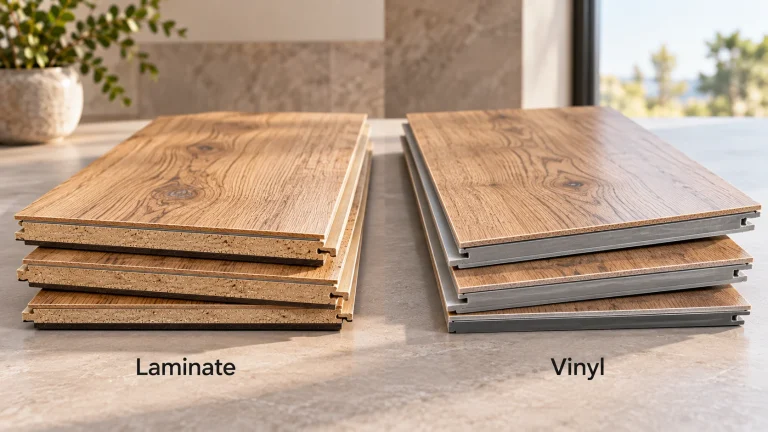
Laminate flooring commonly uses a wood-fiber-based core beneath a decorative surface, while vinyl flooring is a broader category that includes flexible sheet products, luxury vinyl planks and tiles, and rigid-core products.
That means two floors with a similar oak appearance may perform very differently once installed.
For homeowners, developers and contractors, the useful comparison is not simply:
“Which one looks better?”
It is:
“Which complete flooring system suits the room, substrate, traffic, moisture conditions and project budget?”
This guide compares vinyl vs laminate flooring across construction, water resistance, durability, installation, cost, maintenance and different project applications.
For a broader introduction to laminate construction, AC ratings and product selection, see OKBuild’s Laminate Flooring Guide.

Vinyl vs Laminate Flooring at a Glance
| Factor | Laminate Flooring | Vinyl Flooring |
|---|---|---|
| Main construction | Commonly wood-fiber-based core | Vinyl-based flexible or rigid construction |
| Typical formats | Primarily planks and decorative formats | Sheet, plank, tile and rigid-core formats |
| Wood-look designs | Yes | Yes |
| Moisture performance | Product-specific; joints, edges and core matter | Many moisture-resistant options; complete system still matters |
| Wear specification | AC rating and other surface-performance data | Wear layer, surface finish and product testing |
| Installation | Commonly floating click-lock | Glue-down, click-lock, loose-lay or other systems |
| Floor build-up | Plank + pad / underlayment + preparation | Product + backing / adhesive / underlay + preparation |
| Repair | Usually plank replacement | Depends on glue-down, loose-lay or click system |
| Best comparison method | Exact approved laminate model | Exact vinyl construction and approved model |
Neither category has one universal price, durability level or lifespan.
The first step is to identify which type of vinyl flooring is being compared with the laminate.
What Is the Difference Between Laminate and Vinyl Flooring?
The most important difference is the internal construction.
Laminate Flooring Construction
Laminate flooring typically combines:
- Protective surface overlay
- Printed decorative layer
- Wood-fiber-based core
- Balancing backer
The visible timber design is created by the decorative layer rather than by a natural wood wear surface.
This gives manufacturers the ability to reproduce oak, walnut, grey timber, parquet and other visual styles across repeatable product ranges.
The wood-based core also means moisture conditions, joints and edge protection need to be considered carefully.
What Does Vinyl Flooring Include?
Vinyl flooring is a broader flooring category.
Depending on the product, it can include:
- Sheet vinyl
- Luxury vinyl plank
- Luxury vinyl tile
- Flexible glue-down vinyl
- Rigid-core vinyl flooring
These terms do not all describe the same thing.
LVP generally refers to luxury vinyl in plank format.
LVT refers to luxury vinyl tile and is also commonly used within the wider luxury-vinyl flooring category.
SPC is a rigid-core vinyl construction using a solid polymer core.
WPC describes a rigid-core system using an expanded polymer core.
Format and construction are separate questions.
For example, a vinyl plank may be flexible and glue-down, or it may be rigid-core and click-lock.
That is why a buyer should not compare “laminate vs vinyl” without first defining the vinyl product.

LVP vs Laminate: How to Compare Wood-Look Planks
LVP vs laminate is one of the most useful comparisons because both materials are commonly offered as wood-look planks.
From a distance, two approved samples can look very similar.
The differences become clearer when you compare the construction behind the surface.
For flexible glue-down LVP, important questions include:
- Subfloor smoothness
- Adhesive
- Product thickness
- Floor build-up
- Moisture conditions
- Repair procedure
For rigid-core click LVP, buyers should pay more attention to:
- Core construction
- Joint system
- Backing
- Underlayment requirements
- Expansion rules
- Installation layout
For laminate, compare:
- Core construction
- AC rating
- Moisture conditions
- Locking system
- Underlayment
- Total thickness
A thicker laminate plank and a thinner vinyl plank should not be ranked simply by thickness.
Compare two approved products that are intended for the same room.
Real OKBuild Laminate and LVT Product Examples
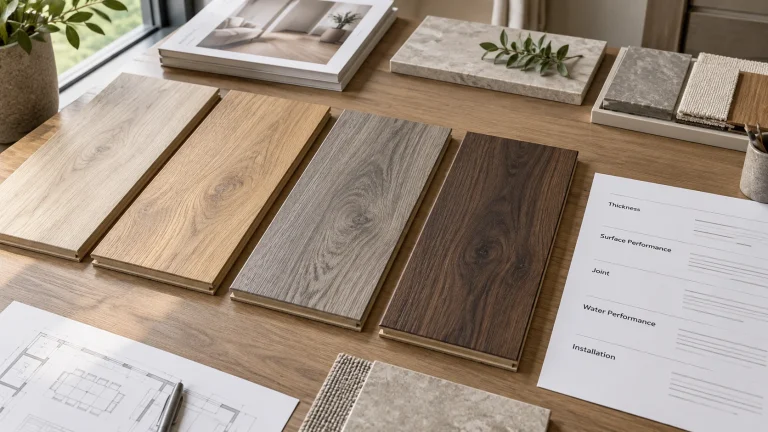
OKBuild’s available flooring ranges demonstrate how visually similar wood-look surfaces can be produced using different flooring constructions.
Current laminate examples include 12mm EF and RY Series planks in multiple wood-look finishes.
The LVT collection includes dry-back wood-grain products in thinner flexible vinyl constructions.
The appearance alone therefore does not identify the flooring system.


Water Resistance: Vinyl vs Laminate Flooring
Vinyl-based flooring generally provides more options when moisture exposure is a major concern because the main material construction is not based on a conventional wood-fiber laminate core.
However, this does not mean every vinyl floor should automatically be described as completely waterproof.
The complete installed system still matters.
Surface Spills and Moisture Below the Floor
There are several different moisture conditions:
- Small surface spills
- Water reaching joints
- Water entering perimeter gaps
- Plumbing leaks
- Moisture coming from a concrete slab
- Continually wet environments
These should not be treated as the same problem.
Some laminate products offer enhanced resistance to surface water through improved joints, edge treatments and core construction.
Vinyl-based products can also vary in joint design, backing and installation method.
The correct approach is to confirm what the exact product is designed and tested to resist.
For a deeper explanation of laminate water-performance claims, see OKBuild’s Waterproof Laminate Flooring Guide.
Bathrooms and Wet Areas
Some manufacturer-approved vinyl flooring systems can be suitable for traditional residential bathrooms.
However, this does not mean every vinyl product can be installed in every wet environment.
Continuously wet areas, shower floors and rooms requiring building waterproofing need separate consideration.
The flooring surface does not replace:
- Waterproof membrane
- Drainage
- Wet-area detailing
- Slip-resistance requirements
- Plumbing protection
For bathrooms, always verify the exact product’s permitted application and installation instructions.
Vinyl vs Laminate Flooring Durability
Durability should not be treated as one single number.
Different flooring products can fail in different ways.
Important factors include:
- Abrasion
- Scratches
- Dents
- Joint damage
- Moisture exposure
- Rolling loads
- Furniture movement
- Cleaning methods
Laminate AC Ratings vs Vinyl Wear Layers
Laminate flooring commonly uses an AC rating to describe abrasion resistance.
This rating primarily relates to surface wear and should not automatically be interpreted as proof of:
- Waterproof performance
- Scratch resistance
- Impact resistance
- Core strength
- Joint strength
Vinyl products commonly specify a wear layer.
Wear-layer thickness may be stated in millimeters or mils.
A mil is one thousandth of an inch, so:
20 mil = approximately 0.508 mm.
This measurement refers to the wear layer rather than the total flooring thickness.
There is no reliable conversion such as:
AC4 laminate = 20 mil vinyl.
They describe different product systems.
For a commercial project, compare the intended-use specification and supporting technical information for each product.
Scratches, Dents and Rolling Loads
Do not assume:
every laminate is more scratch-resistant
or:
every vinyl floor is more durable.
The exact product matters.
Consider expected conditions such as:
- Office chair castors
- Hotel luggage
- Furniture feet
- Retail traffic
- Entrance grit
- Cleaning equipment
If these loads are important, include them in the project flooring specification and request confirmation for the proposed product.
Vinyl vs Laminate Flooring Cost
There is no universal rule that vinyl or laminate is always cheaper.
Both categories include:
- Entry-level products
- Mid-range products
- Higher-specification products
A premium laminate can cost more than a basic vinyl floor, while a premium rigid-core vinyl system can cost more than a basic laminate.
The more useful comparison is installed project cost.
Material Price vs Installed Cost
Compare the same scope for both flooring systems.
| Cost Item | What to Include |
|---|---|
| Flooring | Exact approved model and quantity |
| Waste | Agreed waste allowance |
| Removal | Existing floor removal if required |
| Subfloor | Smoothing, repairs or moisture treatment |
| Underlayment | Separate or attached system |
| Adhesive | Where glue-down vinyl is used |
| Labor | Installation and layout |
| Finishing | Skirting, thresholds and transitions |
| Delivery | Freight, handling and duties where applicable |
| Spare stock | Future repair allowance |
A useful project calculation is:
Installed cost per usable area = total flooring package cost ÷ finished floor area
That is much more useful than comparing only a material price per square foot or square meter.
Maintenance and Replacement Costs
Maintenance strategy also affects long-term cost.
For hotels, apartments, offices and retail projects, ask:
- Can one damaged plank or tile be replaced?
- Does surrounding flooring need to be removed?
- Is adhesive removal required?
- How long will the room be unavailable?
- Is matching replacement stock available?
A slightly cheaper purchase price may not always produce the lowest long-term project cost.
Installation: Laminate vs Vinyl Flooring
Installation is another major difference between the two categories.
Floating Laminate Flooring
Laminate flooring is commonly installed using a floating click-lock system.
The floor typically needs:
- Suitable flat substrate
- Approved underlayment where required
- Expansion allowances
- Correct room layout
- Proper transition details
A floating floor should not be fixed in a way that prevents required movement.
Rigid-Core Click Vinyl
Many rigid-core vinyl products also use click-lock installation.
However, this does not mean they use the same:
- Expansion rules
- Underlayment
- Locking profile
- Room-size limits
- Perimeter requirements
as laminate.
Always follow the exact flooring system.
If a rigid-core product already includes an attached pad, do not automatically add another underlayment layer.
Flexible Glue-Down Vinyl
Flexible LVT or LVP can use a bonded installation.
In this case, substrate preparation becomes especially important.
A thin flexible flooring product can reflect defects underneath it if the base is not properly prepared.
Important checks include:
- Flatness
- Smoothness
- Moisture
- Adhesive compatibility
- Open time
- Cure time
- Traffic restrictions
For more detail on dry-back and self-adhesive LVT systems, see OKBuild’s LVT Flooring Guide.
Finished Floor Height
Do not compare the flooring product thickness alone.
Calculate the complete build-up.
For laminate:
Laminate + attached pad or separate underlayment
For glue-down vinyl:
Vinyl + adhesive + substrate preparation
For rigid-core vinyl:
Rigid core + attached or separate backing where permitted
This can affect:
- Door clearance
- Thresholds
- Skirting
- Stairs
- Tile transitions
- Stone transitions
- Cabinets
- Existing floors
For laminate-specific thickness planning, see OKBuild’s Laminate Flooring Thickness Guide.
Appearance: Which Looks More Like Wood?
Both laminate and vinyl flooring can reproduce convincing timber surfaces.
The final appearance depends on factors such as:
- Decorative image quality
- Grain variation
- Embossing
- Gloss
- Bevels
- Plank dimensions
- Pattern repetition
Neither category should automatically be described as more realistic.
Always evaluate an approved physical sample.
For large rooms, it is even better to view several planks together because a single sample does not show pattern repetition.
Comfort and Sound
Walking feel depends on the full flooring assembly.
A floating laminate floor, flexible bonded vinyl and rigid-core SPC can feel different underfoot.
Sound also depends on:
- Core
- Backing
- Underlayment
- Subfloor
- Building structure
- Installation
For apartments and hotels, do not approve a floor based only on a generic “acoustic backing” claim.
If acoustic performance matters, request documentation for the proposed flooring assembly.
Cleaning and Maintenance
Both materials are generally designed for routine interior maintenance, but the exact cleaning requirements vary.
Before ordering, confirm:
- Approved cleaners
- Wet-cleaning limitations
- Steam-cleaning restrictions
- Stain-removal method
- Furniture protection
- Replacement procedure
Entrance mats and compatible furniture pads can also help reduce grit, scratches and localized surface damage.
Which Flooring Should You Choose for Each Room?
The room should help define the specification rather than automatically determine the material.
| Room / Project Zone | Useful Starting Point | Main Checks |
|---|---|---|
| Bedroom | Compare laminate and LVP on appearance, feel and cost | Surface performance, joints, underlayment |
| Living room | Both can work | Design, traffic, acoustics, replacement |
| Kitchen | Prioritize documented moisture performance | Joints, edges, spills, cleaning |
| Residential bathroom | Evaluate manufacturer-approved vinyl systems carefully | Permitted use, waterproofing, slip resistance |
| Basement | Resolve subfloor moisture first | Moisture testing and control system |
| Apartment | Compare complete assemblies | Acoustic performance and transitions |
| Hotel guestroom | Compare appearance, repair and maintenance | Luggage loads, acoustics, spare stock |
| Office | Check traffic and chair movement | Castors, wear, acoustics |
| Retail | Select by actual commercial traffic | Abrasion, rolling loads, cleaning |
A floor should not be approved simply because the carton uses the word:
waterproof
or:
commercial.
The exact specification needs to match the room.
For projects comparing several material categories, see OKBuild’s Commercial Flooring Materials Guide.

Laminate vs LVT and SPC
Because vinyl flooring includes different constructions, some projects require a more specific comparison.
Laminate vs Flexible LVT Flooring
Flexible LVT can be much thinner than laminate and is often bonded directly to the substrate.
The main comparison should include:
- Subfloor preparation
- Adhesive
- Finished floor height
- Wear-layer specification
- Moisture conditions
- Repair method
Laminate, by contrast, is commonly installed as a floating rigid floor.
For dry-back and self-adhesive product types, see OKBuild’s LVT Flooring Guide.
Laminate vs SPC Flooring
SPC uses a rigid solid polymer core, while laminate commonly uses a wood-fiber-based core.
That difference affects:
- Moisture behavior
- Floor feel
- Construction
- Backing options
- Installation
However, neither category should be evaluated by core material alone.
Joint design, wear surface, backing, installation and project requirements still matter.
For a detailed explanation of SPC construction, see OKBuild’s SPC Flooring Guide.
Laminate and Vinyl Flooring Pros and Cons
| Flooring | Reasons to Consider It | Limitations to Evaluate |
|---|---|---|
| Laminate | Wood-look range, firm plank feel, products with documented abrasion classifications | Moisture conditions, joints, core, underlayment and replacement access |
| Flexible LVT / LVP | Thin floor build-up, wood or stone designs, bonded modular formats | Subfloor smoothness, adhesive, indentation and repair |
| Rigid-Core Vinyl | Click installation, rigid construction, multiple backing options | Joint performance, expansion requirements, underlayment restrictions and load suitability |
No flooring system is automatically best for every project.
The correct choice is the one whose strengths match the room requirements.
Frequently Asked Questions
Is Vinyl Plank Better Than Laminate Flooring?
Not always.
Vinyl plank can be a better option where moisture conditions make the proposed laminate unsuitable.
In a dry room, compare appearance, surface performance, floor feel, installation and installed cost before deciding.
Is Laminate the Same as LVP?
No.
Laminate commonly uses a wood-fiber-based core.
LVP means luxury vinyl plank and describes vinyl flooring in plank format. It can be flexible or rigid-core depending on the product.
Is All Vinyl Flooring Waterproof?
No single claim should automatically be applied to every vinyl product or installed flooring system.
Check the product’s permitted rooms, joints, installation method, substrate conditions and exclusions.
A water-resistant flooring material does not replace required building waterproofing.
Which Is Cheaper: Laminate or Vinyl Flooring?
Either can be cheaper depending on the product and installation scope.
Compare quotations that include:
- Flooring
- Preparation
- Underlayment or adhesive
- Labor
- Transitions
- Delivery
- Spare stock
rather than comparing material price alone.
Which Is Better for Pets?
It depends on the exact flooring.
Compare scratch resistance, stain resistance, cleaning requirements, joint design and spill performance.
Neither laminate nor vinyl should automatically be treated as scratch-proof.
Which Is Better for Kitchens?
A kitchen should prioritize documented moisture performance, joint design, cleaning requirements and appliance-area risks.
Selected vinyl systems or enhanced water-resistant laminate products may both be considered depending on the specification.
Which Is Better for Bathrooms?
Manufacturer-approved vinyl systems are often more commonly considered for moisture-prone bathroom applications.
However, the flooring does not replace required waterproof membranes, drainage or wet-area construction.
Does Thicker Flooring Last Longer?
Not automatically.
Thickness alone does not determine service life.
Wear performance, core construction, joints, traffic, moisture, installation and maintenance all affect long-term performance.
Is Laminate More Scratch-Resistant Than Vinyl?
Not universally.
Scratch performance depends on the exact surface construction and product testing.
Compare specific products rather than making the decision by category name.
Is SPC the Same as Vinyl Flooring?
SPC is one type of rigid-core vinyl flooring.
It does not represent every vinyl product.
Flexible LVT, LVP and sheet vinyl can use different constructions and installation systems.
Compare Flooring Options for Your Project
A good flooring comparison starts with the room requirements and then works backward to the product.
For each proposed floor, compare:
- Construction
- Total thickness
- Wear or abrasion specification
- Water-performance documentation
- Joint system
- Installation method
- Subfloor requirements
- Underlayment or adhesive
- Maintenance
- Replacement procedure
- Warranty
- Spare-stock allowance
That approach is more reliable than choosing only by appearance, thickness or a marketing label.
For a broader laminate overview, see OKBuild’s Laminate Flooring Guide.
For project-specific flooring selection, BOQ review and quotation, contact OKBuild with your drawings, room schedule, quantities, substrate information, preferred design and delivery requirements.